Does creatine make you gain weight?
On this page
Yes, and at first it’s mostly water. A loading week usually adds 2 to 7 lb (1 to 3 kg). On 3 to 5 g a day the rise is smaller and slower, and some people see nothing at all. Either way it stops once your muscles are full.
Three pounds in a week looks like a lot. Some people see it and panic that creatine is making them fat. Others see it and celebrate the new muscle. Both are looking at water, and both are about to judge creatine by the one number that can’t tell them anything.
What we’d do
Expect the scale to go up and ignore it for the first month. Judge creatine by one benchmark, push-ups, a dead hang or a plank, before your first scoop and again at week eight. If you weigh in daily or you’re cutting, skip loading so the rise is small and slow.
Where the weight comes from
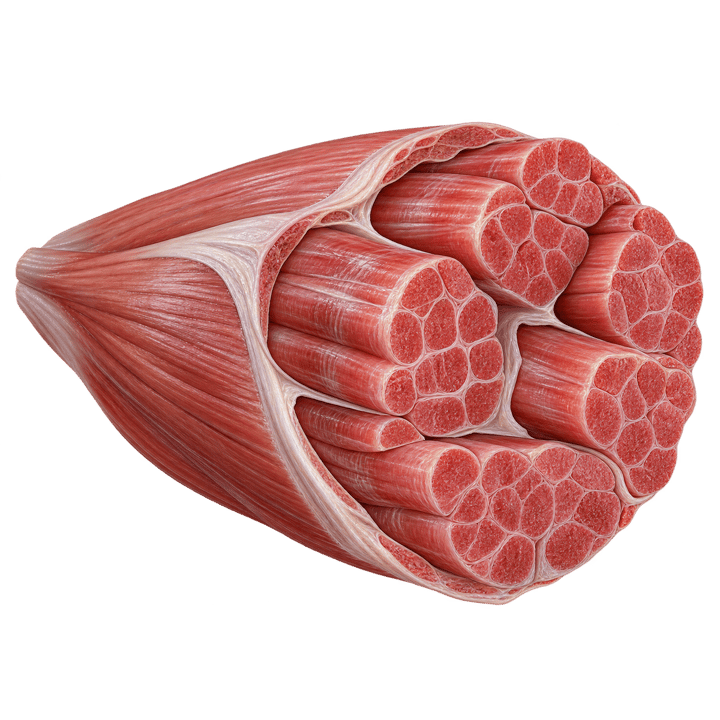
About 95% of your creatine sits in muscle, and creatine pulls water in with it. The International Society of Sports Nutrition calls weight gain the only side effect trials report consistently. A liter of water weighs a kilo (2.2 lb), so the body water and the scale move together.
It’s like dropping a dry sponge in a sink. It gets heavier, and it’s still the same sponge.
What the trials measured
| Trial | What they took | What happened |
|---|---|---|
| Powers 2003, 32 lifters | 25 g a day for 7 days, then 5 g | Body water up 1.37 L in week one, 2.04 L by day 28. Weight up 0.75 kg (1.7 lb) at day 7 and 1.31 kg (2.9 lb) at day 28 |
| Deminice 2016, 13 soccer players | 0.3 g per kg for 7 days | Body water up 2.3 L, weight up 1.0 kg (2.2 lb) |
| Rawson 2011, 20 adults | about 2.3 g a day for 6 weeks | No change in weight or body water |
| Antonio 2021 review | 20 g a day for 5 to 7 days | “Typically” 1 to 3 kg, mostly water |
From these four we built a band. Loading adds 1% to 3% of your body weight by day 7 and then levels off. 3 to 5 g a day adds 0% to 2%, spread over about four weeks. At 180 lb that’s 1.8 to 5.4 lb in a loading week, or up to 3.6 lb over a month on the slow path.
Two surprises in the data
The 2003 trial measured body water with heavy water (deuterium) and found it up 1.37 L after the loading week. That much water should weigh about 1.37 kg. The scale showed only 0.75 kg, and the researchers couldn’t fully explain the gap. They guessed people ate a little less or moved a little more that week. They also found the split between water inside and outside the cells stayed the same.
The 2011 trial went the other way. 20 people took about 2.3 g a day for six weeks, gained nothing on the scale, and still resisted fatigue 7 to 11% better in later sets of knee extensions, so the low dose worked without moving the scale.
When to worry
If the scale keeps climbing after week one of loading, or after the first month on 3 to 5 g, the extra probably isn’t creatine. Food, salt and the normal day-to-day swing of a scale add up fast, so compare weekly averages. The scale tool plots your weigh-in against the band and tells you which side of it you’re on.
5 sources
- Antonio J and others, Common questions and misconceptions about creatine supplementation: what does the scientific evidence really show?, JISSN, 2021pmc.ncbi.nlm.nih.gov
- Powers ME and others, Creatine supplementation increases total body water without altering fluid distribution, Journal of Athletic Training, 2003pmc.ncbi.nlm.nih.gov
- Deminice R and others, Creatine supplementation increases total body water in soccer players: a deuterium oxide dilution study, International Journal of Sports Medicine, 2016pubmed.ncbi.nlm.nih.gov
- Rawson ES and others, Low-dose creatine supplementation enhances fatigue resistance in the absence of weight gain, Nutrition, 2011pubmed.ncbi.nlm.nih.gov
- Kreider RB and others, International Society of Sports Nutrition position stand: safety and efficacy of creatine supplementation in exercise, sport, and medicine, JISSN, 2017pmc.ncbi.nlm.nih.gov