Everything in this guide
Updated November 15, 2026.
The guide
Creatine benefits: how it works and who it helps most
Creatine works through your training, at 3 to 5 g of monohydrate a day. Close to essential if you eat little meat, and a cheap, safe top-up for nearly everyone else.
How creatine works
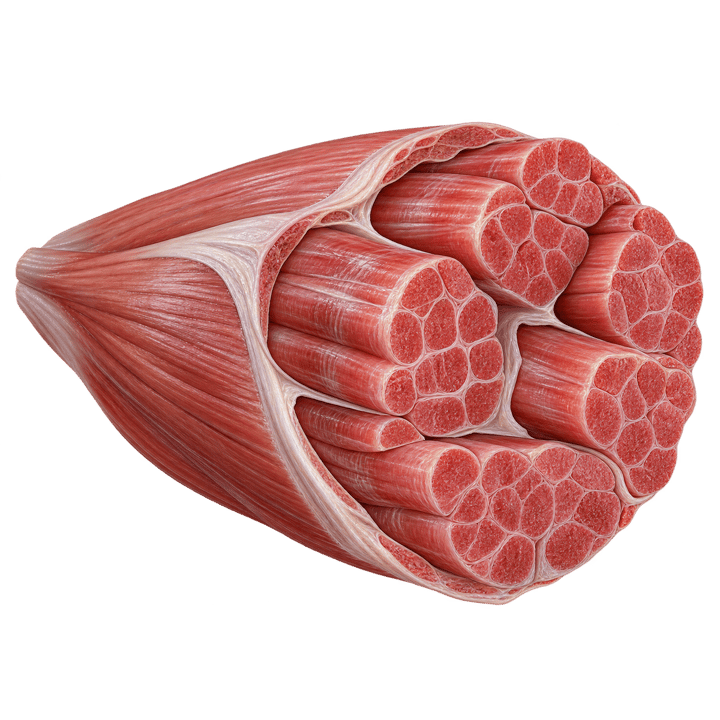
About 95% of your creatine sits in muscle, recharging the energy for the hardest seconds of an effort. You're about three quarters full, and a scoop tops up the rest.
Foods high in creatine: how far meat and fish get you
Meat and fish are the only foods with creatine, and most people get under 1 g a day from them. A scoop holds 4.4 g, the creatine in about 2.4 lb of raw steak.
Creatine for muscle: the studies, the pathway and the plan
With lifting, creatine adds a rep or two to hard sets, and across 35 trials that meant 2.4 lb more lean mass. The studies, the pathway, and a 12-week plan.
Creatine for the brain: what the studies show
Supplements raise brain creatine only 5 to 10%. Memory improved a little across 16 trials, sleep loss is the clearest case, and the biggest trial found little.
High-dose creatine: how much is too much?
Past 5 g a day, most of the extra leaves in your urine. Big athletes may need up to 10 g, studies have used 40 g, and your stomach is the real limit. The scale and rules.
Creatine side effects: which are real, and your kidney test
At 3 to 5 g a day, the real side effects are water weight, a higher creatinine on blood tests and stomach upset from big doses. No kidney or hair harm was found.
Creatine and hair loss: the pros, the cons and what to do
The fear comes from one 2009 study that measured a hormone and never looked at hair. A 2025 trial measured hair for 12 weeks and found no change. What to do if you worry.
Creatine and heat: when it breaks down, and how to store it
Dry creatine powder keeps for years, even at 104°F. In a drink it slowly turns into creatinine, faster when warm or acidic, so mix it and drink it. The measured rates.
Creatine and the law: under-18 sales in New York, California and other states
As of November 2026, New York bars selling muscle-building supplements to under-18s, and California's law starts January 1, 2027. What counts, and what stores must do.
Can teens take creatine? What pediatricians and the research say
We don't give a dose under 18. Pediatricians advise against performance supplements for teens, creatine researchers allow it with supervision, and teen trials are small.
Creatine for vegetarians and vegans, the most improved
Vegetarians start lower and gain the most. In one trial their muscle phosphocreatine rose 66% against 19% in meat eaters. Creatine powder is vegan. Take 3 to 5 g a day.
How much to take, and loading
3 to 5 g of creatine monohydrate a day, every day. Loading at 0.3 g per kg for 6 days, capped at 25 g, is optional and only gets you to the same place sooner.
What happens, week by week
Week one is mostly water on the scale. Stores are full by day 6 if you load or about day 28 if not, the extra rep comes once they're full, and muscle comes over months.
What the scale will do
Creatine puts water on the scale, then stops. Loading usually adds 1 to 3 kg (2 to 7 lb) in a week. 3 to 5 g a day adds less, more slowly, and sometimes nothing.
What creatine does, at its real size
With lifting, creatine adds about 8 points to your strength gain and 2.4 lb (1.1 kg) of lean mass. Brain and mood effects are small. Without training, it does little.
Creatine for women
Yes, the same 3 to 5 g a day, with lifting. After menopause it added about 16 lb (7.5 kg) to the leg press, but bone density didn't change. Pregnant? Ask your doctor.
Creatine after 50
With lifting two or three days a week, yes. In 22 trials of people 57 to 70, creatine added 3 lb (1.37 kg) of lean tissue and more strength. Without lifting, little.
The best creatine to buy, and which form
Plain creatine monohydrate powder. It's 87.9% creatine, almost fully absorbed and the form the trials used. HCl and newer forms did no better. Look for a test mark.
How to tell if it worked
The scale can't tell you. Test push-ups, a dead hang or a plank twice in week one and again at week eight. Count it only if the change beats your own day-to-day gap.
Questions
Can creatine help depression?
Maybe a little. Across 11 trials it moved depression scores 2.2 points, below the 3 points people notice, and the evidence is weak. Never change a medicine for it.
Can you mix creatine with coffee?
Yes. The first creatine trials dissolved it in hot tea. Drink it soon after mixing, since creatine slowly breaks down in warm liquid.
Can you take creatine while cutting?
Yes. Skip loading, keep 3 to 5 g a day, and expect the water to hide two to four weeks of fat loss on the scale. Watch your waist and weekly average instead.
Can you take creatine while pregnant?
There isn't enough research in pregnancy or breastfeeding to give a dose. Ask your doctor or midwife before you take it.
Do creatine gummies work?
They can, if each one holds what the label says. A 2026 trial with checked 5 g gummies worked, but gummy content varies a lot, so look for a test mark.
Do vegetarians get more from creatine?
For muscle, probably. Vegetarians start lower, so the same dose fills more. For the brain, a 123-person trial found no extra benefit for vegetarians.
Do you need to load creatine?
No. 20 g a day for 6 days and 3 g a day for 28 days reached the same muscle level. Loading buys you about three weeks and more water on the scale.
Does creatine cause cramps?
No. Over a season of college football in the heat, players on creatine had fewer cramps, heat illness and muscle strains than players not taking it.
Does creatine cause hair loss?
No good evidence. One 2009 study saw a hormone (DHT) rise and never looked at hair. A 2025 trial measured hair and found no difference.
Does creatine help the brain?
A little. Across 16 trials, memory and processing speed improved slightly, and overall thinking and planning didn't change.
Does creatine help when you haven't slept?
In one trial of 15 people, a single large dose (0.35 g per kg) held up thinking speed through a night without sleep. That's a trial dose, and sleep is the fix.
Does creatine make you bloated?
Usually it's your stomach reacting to a big dose. In one trial two 5 g doses a day were no worse than placebo, while one 10 g dose nearly doubled the diarrhea.
Does creatine make you fat?
No. Trials lasting from one week to two years found no gain in fat. The weight you see at first is water, and calories are what decide fat.
Does creatine make you gain weight?
Yes, mostly water at first: 2 to 7 lb (1 to 3 kg) in a loading week, less and slower on 3 to 5 g a day. It stops once your muscles are full.
Does creatine work without exercise?
Barely. Across 35 trials lean mass didn't move without exercise. One 2026 trial found about 2 lb (1 kg) at 10 g a day in 13 people, on a scan that counts water.
How long does creatine take to work?
Your muscles are full in about 6 days if you load and about 4 weeks on 3 to 5 g a day. The extra rep on hard sets shows up once they're full.
How much creatine should I take?
3 to 5 g of creatine monohydrate a day, rest days too. Loading at 0.3 g per kg for 6 days is optional and only gets your muscles full about three weeks sooner.
Is 10 grams of creatine too much?
Not for most adults, but split it. One 10 g dose gave 56% of players diarrhea, against 29% on two 5 g doses and 35% on placebo.
Is creatine bad for your kidneys?
Not in healthy people. It raises creatinine about 0.14 mg/dL, so the kidney score looks lower, but kidney filtering measured directly didn't drop.
Is creatine good after 50?
With lifting, yes. Across 22 trials of people in their late 50s to 70, creatine added about 3 lb (1.37 kg) more lean tissue and more strength.
Is creatine HCl better than monohydrate?
No. In two trials HCl did no better than monohydrate, and monohydrate is already 87.9% creatine and almost fully absorbed. Buy plain monohydrate.
Is creatine safe?
For healthy adults at 3 to 5 g a day, yes. Water weight and a higher creatinine number are the real effects, and big single doses can upset your stomach.
Should I stop creatine before a blood test?
Tell your doctor instead. Your stores take about a month to fall, so a few days off probably won't clear the creatinine rise, and no study has timed it.
Should I take creatine on rest days?
Yes, the same dose. About 1 to 2% of the creatine in your muscles breaks down every day, trained or not, so the top-up has to be daily too.
Should women take creatine?
Yes, at the same 3 to 5 g, with lifting. After menopause, leg press rose about 16 lb (7.5 kg) more with creatine. Bone density didn't change.
Should you take creatine on a GLP-1?
Maybe, but lifting and protein come first. No trial has tested creatine in people taking semaglutide or tirzepatide yet.
What happens when you stop taking creatine?
Your stores drift back to where they started over about a month, the water goes with them, and they never drop below your starting level.
When should I take creatine?
Whenever you'll remember. A small trial leaned toward after training, but the daily total is what fills your muscles, so take it with a meal you never skip.
Why did my creatinine go up on creatine?
Creatine breaks down into creatinine, so fuller muscles put more in your blood, about 0.13 to 0.14 mg/dL on average. Ask your doctor about a cystatin C test.
Myths
Creatine is just water weight
Week one is mostly water, 1.37 L in one trial. But with lifting, lean mass rose 2.4 lb (1.1 kg) more than lifting alone across 35 trials, and muscle fibers grew more.
You have to load creatine first
20 g a day for 6 days and 3 g a day for 28 days ended at the same 20% rise. Loading only gets you there about three weeks sooner, with more water and more stomach upset.
Creatine makes your hair fall out
The fear comes from one 2009 study of 20 rugby players that measured a hormone and never looked at hair. A 2025 trial measured hair for 12 weeks and found no difference.
Creatine damages your kidneys
It raises creatinine, the number a kidney test uses, by about 0.14 mg/dL. Kidney filtering measured directly didn't drop across 26 trials. With kidney disease, ask first.
Creatine is a kind of steroid
Your liver and kidneys make creatine, and 2.4 lb of raw steak holds a scoop's worth. Steroids are a different molecule. Testosterone didn't change in a 12-week trial.
After your workout is the best time to take creatine
A small 2013 trial leaned toward after training, but the difference wasn't significant. The daily total is what fills your muscles, so take it whenever you'll remember.
Coffee cancels out creatine
In two of six studies, big daily caffeine doses during a loading week blunted creatine. A coffee before training once your stores are full didn't, and often helped.
You need to cycle off creatine
When you stop, your stores drift back to where they started over about a month, and never below. A break only empties what you filled, so there's nothing to reset.
HCl and other new forms work better than monohydrate
Monohydrate is already 87.9% creatine, and about 99% of it is taken up or passed in urine. HCl did no better in two head-to-head trials, and no other form has beaten it.
Tools
How much creatine?
Your dose, the loading option, both fill curves and the day your stores are full.
What the scale will do
The usual creatine water by day, the date it levels off, and your weigh-in against it.
Prove it worked
Push-ups, dead hang or plank on day one and at week eight. Is the change bigger than your noise?
Creatinine check
Why your creatinine may be up, how much creatine adds, and the test to ask for.
The cost of a real 5 g day
Powder, capsules or gummies: the cost per day and per year, and how many make 5 g.
Will creatine work for me?
The quiz: eight taps, your verdict, your dose, your dates and the one test that tells you.
Creatine studies, tips and resources
Every tip and study on this site in one plain line, with a link to copy and pass on.
Track it in Gyroscope
Photograph your tub to log it, weigh in, log your sets and take the benchmarks.