How to tell if it worked
On this page
The scale can’t tell you, because it goes up for everyone who takes creatine. Test one benchmark, push-ups, a dead hang or a plank, twice in your first week, a few days apart, and again at week eight. Count it as a real change only if it’s bigger than the gap between your two first tries.
Most people decide whether creatine worked by the scale, the mirror, the pump in the gym, or a feeling that the bar moved easier. Every one of those can fool you. The scale jumps from water whether or not your training improves. The mirror and the feeling move with what you hope to see, and with sleep, food and mood.
The effect you’re looking for is a few percent, an extra rep or two on a hard set. Small changes like that hide inside ordinary day-to-day swings unless you measure them the same way twice.
What we’d do
Pick one test you can do at home, do it twice before or just after your first scoop, a few days apart, and write both numbers down. Keep training at least twice a week. At week eight, test again in the same conditions. If the change is bigger than the gap between your first two tries, it’s real. If not, that’s a fair answer too.
If you remember three things
- Ignore the scale. It goes up from water for everyone.
- Test twice at the start. The gap between the two tries is your own noise.
- Retest at week eight, same conditions. Only a change bigger than your noise counts.
It’s like checking a new pair of glasses
You don’t know if new glasses help by how they feel on your face. You check the same line on the same eye chart, at the same distance, before and after. A benchmark is your eye chart. Same test, same conditions, and the number decides.
Why can’t the scale or the mirror tell you?
The scale goes up in the first weeks for nearly everyone who takes creatine, because water travels into muscle with it. A loading week typically adds 1 to 3 kg (2 to 7 lb). That tells you the creatine got into your muscles. It tells you nothing about whether your training improved.
Even a body scan gets fooled. In a 2025 trial, a week of 5 g a day added 0.51 kg (1.1 lb) of lean mass on a scan before anyone had lifted, and the researchers think most of it was water.
Which test should you pick?
One you can repeat exactly, with nothing you might not have at week eight. These three need no gym, and strength.guide uses the same rules for them.
| Test | How to do it | What you write down |
|---|---|---|
| Push-ups | One unbroken set, chest close to the floor, arms straight at the top. From your toes or your knees, the same both times. | Reps |
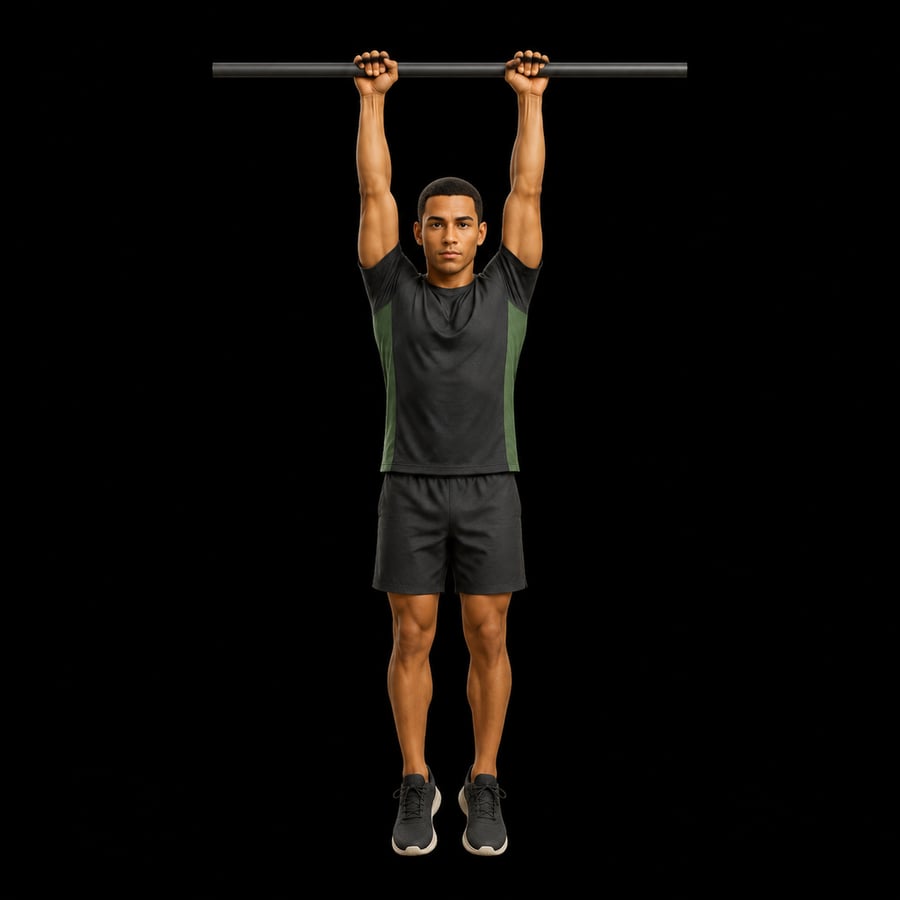
| Dead hang | Straight arms, both hands, no straps. Time from feet off the floor until a hand lets go. | Seconds |
| Plank | Forearms and toes, body straight. Time until your hips drop. | Seconds |
Do every test at the same time of day, after the same warm-up, and not within 48 hours of a hard session for those muscles. If you’re 60 or older, the 30-second chair stand works well too, and strength.guide shows how to do it.
Why test twice at the start?
Because your numbers wobble on their own. A dead hang can come out differently on a good morning and a tired one, before creatine has anything to do with it. The gap between your two first tries is your own noise, the size of change that means nothing for you.
Compare week eight with your better first try. If the change is bigger than the gap between your two first tries, count it as real.
Say you did 20 push-ups on Monday and 21 on Thursday. Your noise is 1. At week eight you do 25. That’s 4 more than your better try, against noise of 1, so it’s a real change. If you’d done 22, that’s 1 more, the same as your noise, and it doesn’t count.
When is week eight?
Fifty-six days after your first test. If you test on Monday, November 16, your retest is Monday, January 11. By then your stores have been full for about four weeks on 3 to 5 g a day, or about seven weeks if you loaded, so the extra reps have had time to add up. The prove-it tool works out the date, draws your two numbers against your noise, and can put the retest in your calendar.
How big a change should you expect?
A few percent from creatine, on top of whatever your training does. In lifting trials, reps at the same weight rose 26% with creatine against 12% with training alone, and strength rose 20% against 12%. Creatine’s share is the gap between those numbers, about 8 to 14 percentage points, and your training gets credit for the rest.
Keep a training log as well as the benchmark. If your push-ups go up and you also trained harder, both get some credit. If you didn’t train, creatine has almost nothing to show.
For how your number compares with other people your age, strength.guide has bands for push-ups, the dead hang and the plank.
What if nothing changed?
Then eight weeks of real training with no change bigger than your noise is a fair result. Some people get more from creatine than others. In a 2004 study of 11 men who loaded for 5 days, 3 took up a lot of creatine, 5 took up a moderate amount and 3 barely took up any. The ones who took up the least started with the fullest stores. That study is far too small to say what share of people respond, so we don’t give a number.
People who eat a lot of meat and fish start fuller, so they have less room to fill. Vegetarians start lower, and in a 2003 trial they gained more stored creatine, lean tissue and total work on the same dose.
If nothing moved, check three things before you quit. Did you take it every day? Did you train at least twice a week? Were the test conditions really the same? If all three are yes, the money may do more as food protein. protein.guide has your daily protein range.
7 sources
- Rawson ES, Volek JS, Effects of creatine supplementation and resistance training on muscle strength and weightlifting performance, J Strength Cond Res, 2003pubmed.ncbi.nlm.nih.gov
- Antonio J and others, Common questions and misconceptions about creatine supplementation: what does the scientific evidence really show?, JISSN, 2021pmc.ncbi.nlm.nih.gov
- Syrotuik DG, Bell GJ, Acute creatine monohydrate supplementation: a descriptive physiological profile of responders vs. nonresponders, J Strength Cond Res, 2004pubmed.ncbi.nlm.nih.gov
- Burke DG and others, Effect of creatine and weight training on muscle creatine and performance in vegetarians, Med Sci Sports Exerc, 2003pubmed.ncbi.nlm.nih.gov
- Rawson ES and others, Low-dose creatine supplementation enhances fatigue resistance in the absence of weight gain, Nutrition, 2011pubmed.ncbi.nlm.nih.gov
- Hultman E and others, Muscle creatine loading in men, J Appl Physiol, 1996pubmed.ncbi.nlm.nih.gov
- Desai I and others, The effect of creatine supplementation on lean body mass with and without resistance training, Nutrients, 2025pmc.ncbi.nlm.nih.gov