Foods high in creatine: how far meat and fish get you
On this page
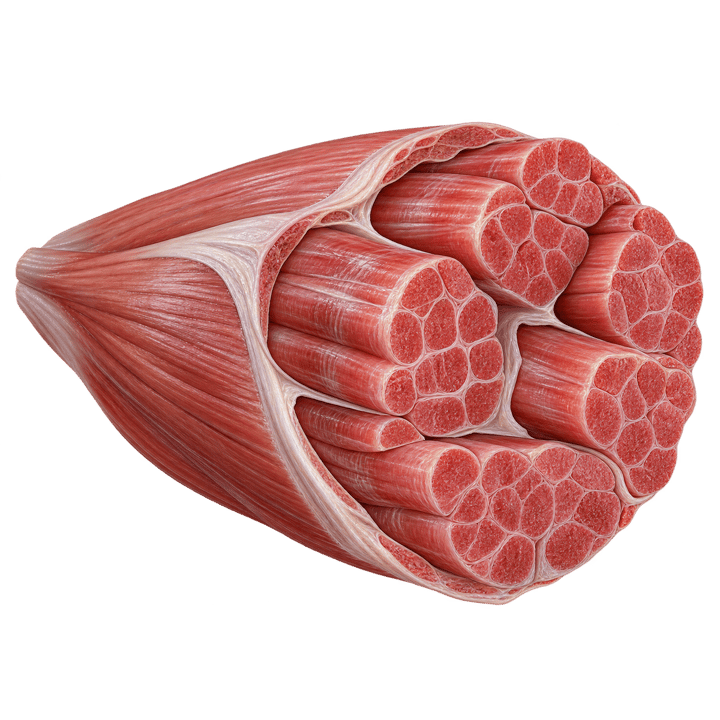
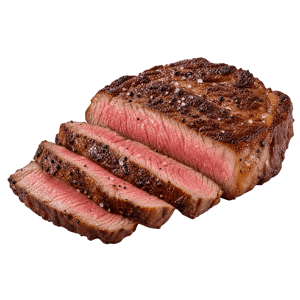
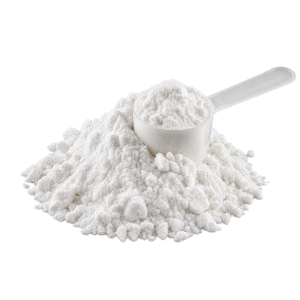
Creatine is in meat and fish because it’s in muscle, and no plant food has any. If you want to, and if you can, eating meat or fish most days is the natural way to keep your stores up, and it gets most people to about four fifths full. But food is a small source next to a scoop. A 4 oz portion of raw beef or chicken holds about 0.44 g, the average American gets about 0.7 g a day from food, and one 5 g scoop carries 4.4 g, the creatine in about 2.4 lb of raw steak.
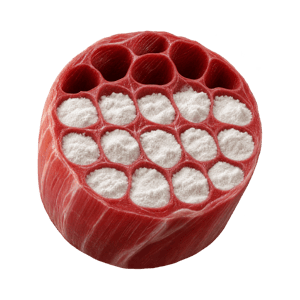
Supplement labels say creatine is naturally found in red meat and fish, and lists of creatine-rich foods make it sound like a steak dinner could stand in for a scoop. Other people assume the powder is a lab-made drug with nothing to do with food. Both get the size wrong. The creatine in a tub is the same molecule as the creatine in a steak, and you’d need a lot of steak.
What we’d do
If you eat meat or fish, keep a portion in most days, if you want to and if you can. It keeps your stores at about four fifths full and covers protein too. Count it honestly, though. Food keeps you where you are and won’t fill you up, so if you want full stores for training, that takes 3 to 5 g a day, which in practice means a scoop. If you’re vegetarian or vegan, food gives you none, and the powder is vegan.
If you remember three things
- Creatine is a meat and fish nutrient. Your body makes about half of what it uses, and food brings the rest, but only from animal muscle.
- Food gets you to about four fifths. People who eat meat or fish most days start at about 130 of a ceiling near 160.
- One scoop is about 10 portions. A 5 g scoop holds the creatine of about 10 raw 4 oz portions of beef.
Where your creatine comes from
Your muscles hold about 95% of your creatine, and every day about 1% to 2% of it breaks down into creatinine and leaves in your urine (ISSN 2017). For a 154 lb (70 kg) man aged 20 to 39, that’s about 2 g a day, and less for women and older people, since they carry less muscle (Brosnan 2011). Your liver and kidneys make new creatine from two amino acids, arginine and glycine, with a methyl group borrowed from a third, methionine. In people who eat meat, food replaces about half of the daily loss, and in vegetarians the body makes nearly all of it.
- Used up each day, a 154 lb man aged 20 to 39
- Made by your liver and kidneys, about
- From food, meat or fish most days, up to
- From food, the average American
- From food, vegan
- One 5 g scoop
Making it costs your body something. It uses up about 40% of the spare methyl groups your body hands out, which it needs for plenty of other work, and 20% to 30% of the part of arginine it uses (Brosnan 2011). The researchers who measured that call creatine a “carninutrient”, something adults only get from animal foods or a supplement (Brosnan 2016).
Think of your stores as a phone that charges two ways. Your body is a slow charger that’s always plugged in, and meat and fish are a second one that keeps you near 80%. A scoop is the fast charger that takes you to 100%.
How much creatine is in meat and fish
In 1997 Harris and colleagues measured creatine in raw meats. Uncooked chicken, beef and rabbit each held about 30 mmol per kg, which works out to about 3.9 g of creatine in a kg of raw meat. Ox heart held 22.5 and ox liver only 2.3. The liver helps make your creatine but sends it out to your muscles, so a plate of liver carries almost none. The International Society of Sports Nutrition puts a pound of raw beef or salmon at about 1 to 2 g.
- Beef, 4 oz raw
- Chicken, 4 oz raw
- Salmon, 4 oz raw, up to 0.25 to 0.5 g
- Beef heart, 4 oz raw
- Beef liver, 4 oz raw
- Beans, lentils, tofu
- One 5 g scoop
The 1992 study that started the creatine era worked out that one 5 g dose holds the creatine in about 1.1 kg (2.4 lb) of fresh, raw steak (Harris 1992). In salmon, at 1 to 2 g a pound, it’s 2.2 to 4.4 lb. In beef heart it’s about 3.3 lb, and in beef liver about 32 lb.
Does cooking destroy creatine?
Cooking destroys some of it. Heat slowly turns creatine into creatinine, the same breakdown that happens in a warm drink. In 2006 Purchas and colleagues cooked beef from 31 heifers to 71°C (160°F) and found less creatine after cooking than before. So the 2.4 lb figure is raw steak, and a cooked steak of the same size carries less. Creatine and heat has the measured rates for powder and drinks.
How much do people actually eat?
Most people eat less than you’d think. In US national surveys from 1999 to 2018, covering 89,161 people, the average was 0.7 g of creatine a day from food, and 68.6% of adults got less than 1 g (Korovljev 2021). The highest adult average in any survey round was 0.87 g, in 2011 to 2012. Those numbers are worked out from food records with one average value for every meat, so they’re estimates. A 2021 review puts a normal diet with meat at 0.75 to 1.5 g a day, and a vegan diet at none (Kreider and Stout 2021).
People probably ate a lot more creatine in the Paleolithic than they do now, and some Greenland and Alaskan Inuit, whose diets are mostly meat and fish, still do (Brosnan 2016).
Can you eat enough to fill your stores?
Not unless you eat a lot of meat. Your muscles’ ceiling is about 160 mmol per kg of dry muscle (ISSN 2017). Vegetarians and vegans sit at 90 to 110, a mixed diet at about 120, and the meat eaters in a 2003 trial started at about 130 (Burke 2003).
-
 Vegetarian or vegan about two thirds about 100 of 160
-
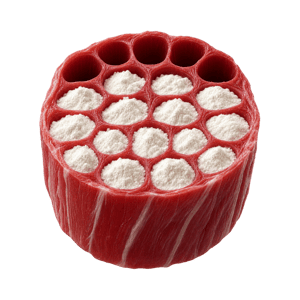 Meat a few times a week about three quarters about 120 of 160
-
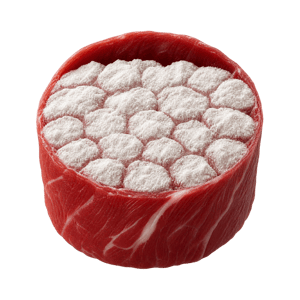 Meat or fish most days about four fifths about 130 of 160
-
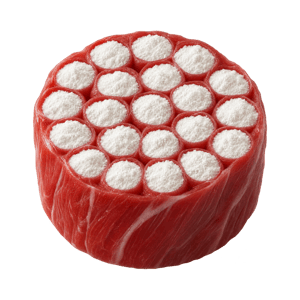 After 28 days of 3 to 5 g full about 160, the ceiling
Food moves you from about two thirds full to about four fifths. Filling up took 3 g a day for 28 days in the 1996 trial that timed it (Hultman 1996). In raw meat, a 3 to 5 g scoop is about 1.5 to 2.4 lb a day, on top of what you already eat. Some people do eat that much, but for most it’s a lot of meat to eat every day for a small top-up.
If you don’t eat meat or fish
Plants have no creatine, so a vegan diet brings none, and vegetarians who eat eggs and dairy still run lower than meat eaters, about 10% to 15% lower in muscle. You can watch it happen. In a 2018 trial, women who ate meat switched to a vegetarian diet, and after 3 months the ones on placebo had lost 15% of the creatine in their thigh muscle (Blancquaert 2018). Your body makes more creatine than a meat eater’s does, but not enough to close the gap.
That’s why vegetarians and vegans gain the most from a scoop. The powder is made from two chemicals with no animal products, so it fits a vegan diet. Creatine for vegetarians and vegans has the trials.
For teenagers
Food first is what pediatricians advise for young athletes. A pediatric sports medicine physician writing for the American Academy of Pediatrics in October 2026 said “a food-first regimen works best”, and we don’t give a supplement dose to anyone under 18. Meat, fish, eggs, dairy and beans also bring the protein a growing athlete needs. Can teens take creatine? has the rest.
The food plan
If you want to keep your creatine up the natural way, and you can.
- Eat meat or fish most days. A 4 oz portion of beef, chicken or salmon brings about a quarter to half a gram. Fish twice a week covers your omega-3 too, and fats.guide has which fish have the most.
- Count it as a top-up. Food keeps you at about four fifths full. It won’t fill the last fifth.
- Cover your protein. protein.guide has how to eat more protein from everyday foods.
- Lift two or three days a week. Creatine from food or from a scoop does its work in hard sets. Creatine for muscle has why.
- Want your stores full? Add 3 to 5 g of monohydrate a day. The best creatine to buy and the dose calculator have the rest.
12 sources
- Harris RC, Lowe JA, Warnes K, Orme CE, The concentration of creatine in meat, offal and commercial dog food, Research in Veterinary Science, 1997pubmed.ncbi.nlm.nih.gov
- Harris RC, Söderlund K, Hultman E, Elevation of creatine in resting and exercised muscle of normal subjects by creatine supplementation, Clinical Science, 1992pubmed.ncbi.nlm.nih.gov
- Kreider RB and others, International Society of Sports Nutrition position stand: safety and efficacy of creatine supplementation in exercise, sport, and medicine, JISSN, 2017pmc.ncbi.nlm.nih.gov
- Kreider RB, Stout JR, Creatine in health and disease, Nutrients, 2021pmc.ncbi.nlm.nih.gov
- Brosnan ME, Brosnan JT, The role of dietary creatine, Amino Acids, 2016pubmed.ncbi.nlm.nih.gov
- Brosnan JT, da Silva RP, Brosnan ME, The metabolic burden of creatine synthesis, Amino Acids, 2011pubmed.ncbi.nlm.nih.gov
- Korovljev D, Todorovic N, Stajer V, Ostojic SM, Temporal trends in dietary creatine intake from 1999 to 2018: an ecological study with 89,161 participants, JISSN, 2021pmc.ncbi.nlm.nih.gov
- Purchas RW, Busboom JR, Wilkinson BH, Changes in the forms of iron and in concentrations of taurine, carnosine, coenzyme Q10, and creatine in beef longissimus muscle with cooking and simulated stomach and duodenal digestion, Meat Science, 2006pubmed.ncbi.nlm.nih.gov
- Burke DG and others, Effect of creatine and weight training on muscle creatine and performance in vegetarians, Medicine and Science in Sports and Exercise, 2003pubmed.ncbi.nlm.nih.gov
- Blancquaert L and others, Changing to a vegetarian diet reduces the body creatine pool in omnivorous women, but appears not to affect carnitine and carnosine homeostasis, British Journal of Nutrition, 2018pubmed.ncbi.nlm.nih.gov
- Hultman E and others, Muscle creatine loading in men, J Appl Physiol, 1996pubmed.ncbi.nlm.nih.gov
- Wolf S, My 15-year-old wants to take creatine for sports performance. Is creatine safe for teen athletes?, HealthyChildren.org, American Academy of Pediatrics, last updated October 15, 2026healthychildren.org