Creatine for muscle: the studies, the pathway and the plan
On this page
Creatine builds muscle the slow way, through the extra work it lets you do. Fuller stores give you a rep or two more on each hard set, and across 35 trials that added up to 2.4 lb (1.1 kg) more lean mass than lifting alone. Without training it did nothing you could measure.
There are two stories about creatine and muscle, and they cancel each other out. One says it builds muscle on its own, like a powder version of a steroid. The other says the gains are all water and disappear when you stop. The trials say something in between and more useful, which is that creatine makes your training a little bigger, and the training does the building.
What we’d do
If you lift, or plan to start, take 3 to 5 g of creatine monohydrate every day and keep lifting at least two or three days a week, adding a rep or a little weight whenever you can. Test one lift or benchmark before you start and again at week eight.
How it works, step by step
- ScoopAbout 99% of a swallowed dose of monohydrate reaches the blood or leaves in urine. Blood levels peak about an hour later.
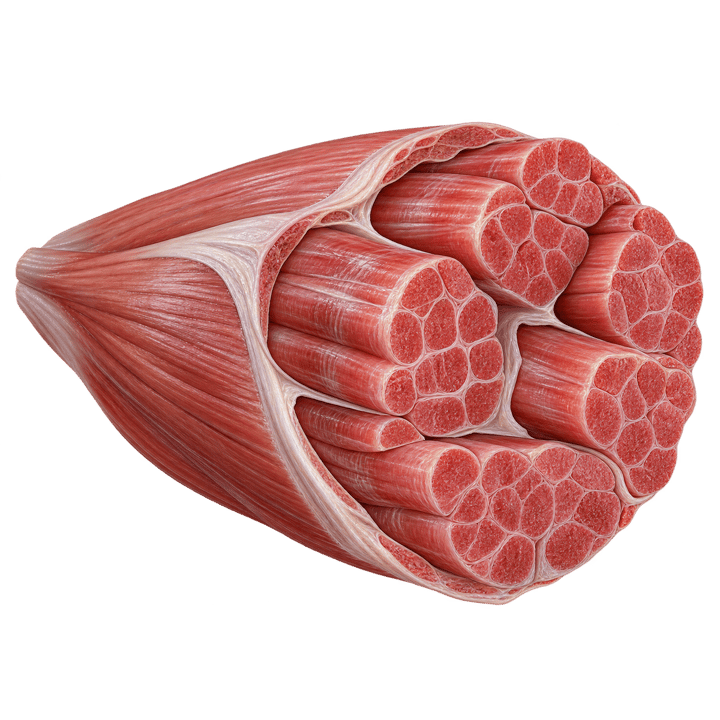
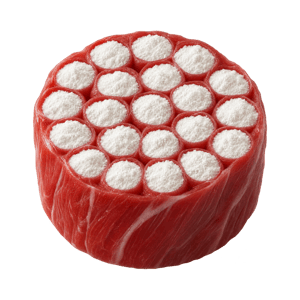
- MuscleA transporter pulls it into muscle, where about 95% of your creatine lives. About two thirds of it is stored as phosphocreatine.
- Hard setIn the first seconds of an all-out effort, phosphocreatine hands its phosphate back to ADP and rebuilds ATP, the fuel a muscle burns.
- Extra repFuller stores refill faster between efforts, so you get a rep or two more on a hard set, or a faster sprint late in a game.
- More volumeMore reps every session adds up to more total training, and training is what builds the muscle and the strength.
The key step is the third one. Your muscle only holds a few seconds’ worth of ATP, the molecule it burns to contract. Phosphocreatine is the backup that rebuilds it on the spot, and on a normal diet your muscles are only about three quarters full of it. A daily dose tops up the rest, which raises muscle creatine by 20% to 40% (ISSN 2017), and that’s what buys the extra rep.
It’s like a battery pack for your phone. It doesn’t run the phone, but it keeps the screen from going dark in the moment you need it most, and in a hard set that moment is the last rep or two.
What the studies found
The first big pooling came in 2003. Rawson and Volek gathered 22 studies of creatine with weight training. Strength rose 20% on creatine against 12% on placebo, and the number of reps people could do at the same share of their max rose 26% against 12%.
Creatine and liftingPlacebo and lifting
- Strength gain
- Reps at the same share of your max
The newer pooled studies agree on the direction and add detail.
| Study | What they pooled | What creatine added |
|---|---|---|
| Rawson and Volek, 2003 | 22 studies with lifting | Strength up 20% against 12% |
| Lanhers, 2015 and 2017 | 60 lower body and 53 upper body studies | Small gains in strength for efforts under 3 minutes |
| Delpino, 2022 | 35 trials, 1,192 people | 1.1 kg more lean mass with lifting, 0.03 kg without exercise |
| Chilibeck, 2017 | 22 trials, people aged 57 to 70 | 1.37 kg more lean tissue, and stronger chest and leg presses |
| Wang, 2026 | 63 studies, 1,489 people | More strength and lean mass, no change in fat mass |
After a loading week, performance in hard, repeated efforts usually goes up 10% to 20%, depending on how much phosphocreatine rises (ISSN 2017). That’s why creatine helps sprints, jumps and sets of 5 to 15 reps, and does little for a marathon.
The best case against it
Creatine pulls water into muscle along with it, and the scanners that measure lean mass count that water as lean tissue. In a 2025 study, 63 adults took 5 g a day. After a one-week start, the creatine group had 0.51 kg more lean mass than the controls, and then both groups gained about 2 kg over 12 weeks of lifting, with no extra gain from creatine. The authors think the early bump was mostly water, and that more than 5 g a day may be needed to add muscle on top of training.
The size of the effect also varies. Across 35 trials, men gained 1.46 kg of lean mass and women 0.29 kg, which was too small to be sure of. And in a small 2004 study, only 3 of 11 men who loaded responded fully. The responders started with the lowest stores and the most fast-twitch fiber.
We still think creatine helps, because the strength results don’t depend on any scanner and they point the same way across more than 100 studies. But the gains are modest, and they come from the training it allows.
Who gains the most
- People who start low. Vegetarians and vegans begin with less creatine in their muscles. In the 2003 trial that compared diets, vegetarians on creatine gained more phosphocreatine, more lean tissue and more work capacity than meat eaters on creatine. Creatine for vegetarians and vegans has the numbers.
- People who train hard and often. More hard sets give the extra rep more chances to add up.
- Younger lifters, for strength. In the 2026 pooling of 63 studies, the strength effect was bigger in studies of younger people.
- Older lifters, for lean tissue. People in their late 50s to 70 who lifted two or three days a week gained 1.37 kg more lean tissue on creatine. Creatine after 50 covers it.
The people who gain least are the ones who don’t train. In the 35-trial pooling, lean mass rose 0.03 kg without exercise, which is nothing.
The protocol
Twelve weeks, built on the 1996 loading trial and the pooled lifting studies.
- Before your first scoop, test one thing twice. Push-ups to failure, a dead hang or your best set of 5 on one lift. Keep the better of two tries on different days. Our prove it calculator tells you what change is real.
- Start 3 to 5 g a day, every day, with a meal. Your muscles are full by about day 28. If you need it working within a week, load 24 g a day for 6 days at 176 lb (0.3 g per kg, capped at 25 g), split into four servings of about 6 g, then drop to 3 to 5 g.
- Lift two to four days a week and add a little. One more rep or a small step up in weight when a set feels easier. strength.guide has a simple program.
- Eat enough protein. protein.guide works out your daily range.
- Ignore the scale for the first month. It goes up for everyone, and it’s mostly water. What the scale will do shows your band.
- Retest at week eight, day 57, the same way. A change bigger than your noise means it’s working with your training. No change means look at the training first.
- Keep going. There’s no need to cycle off. If you stop, your stores drift back to where they started over about 30 days.
12 sources
- Kreider RB and others, International Society of Sports Nutrition position stand: safety and efficacy of creatine supplementation in exercise, sport, and medicine, JISSN, 2017pmc.ncbi.nlm.nih.gov
- Antonio J and others, Common questions and misconceptions about creatine supplementation: what does the scientific evidence really show?, JISSN, 2021pmc.ncbi.nlm.nih.gov
- Hultman E and others, Muscle creatine loading in men, J Appl Physiol, 1996pubmed.ncbi.nlm.nih.gov
- Rawson ES, Volek JS, Effects of creatine supplementation and resistance training on muscle strength and weightlifting performance, J Strength Cond Res, 2003pubmed.ncbi.nlm.nih.gov
- Lanhers C and others, Creatine supplementation and lower limb strength performance: a systematic review and meta-analyses, Sports Medicine, 2015pubmed.ncbi.nlm.nih.gov
- Lanhers C and others, Creatine supplementation and upper limb strength performance: a systematic review and meta-analysis, Sports Medicine, 2017pubmed.ncbi.nlm.nih.gov
- Delpino FM and others, Influence of age, sex, and type of exercise on the efficacy of creatine supplementation on lean body mass, Nutrition, 2022pubmed.ncbi.nlm.nih.gov
- Wang H and others, Resistance training combined with creatine supplementation: a three-level meta-analysis of multidimensional outcomes from strength enhancement to body composition remodeling, JISSN, 2026pmc.ncbi.nlm.nih.gov
- Desai I and others, The effect of creatine supplementation on lean body mass with and without resistance training, Nutrients, 2025pmc.ncbi.nlm.nih.gov
- Chilibeck PD and others, Effect of creatine supplementation during resistance training on lean tissue mass and muscular strength in older adults: a meta-analysis, Open Access Journal of Sports Medicine, 2017pmc.ncbi.nlm.nih.gov
- Burke DG and others, Effect of creatine and weight training on muscle creatine and performance in vegetarians, Medicine and Science in Sports and Exercise, 2003pubmed.ncbi.nlm.nih.gov
- Syrotuik DG, Bell GJ, Acute creatine monohydrate supplementation: a descriptive physiological profile of responders vs. nonresponders, J Strength Cond Res, 2004pubmed.ncbi.nlm.nih.gov