Creatine and heat: when it breaks down, and how to store it
On this page
Heat can’t hurt creatine that’s dry. The powder showed no breakdown after more than 3 years stored at 104°F (40°C). Once it’s dissolved, it slowly turns into creatinine, a waste product your muscles can’t use, and it goes faster the warmer and more acidic the drink. So keep the tub dry, mix your scoop when you’re about to drink it, and finish it.
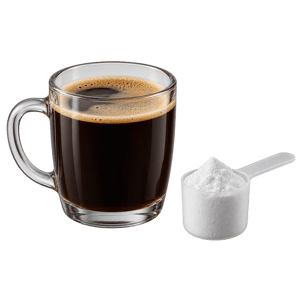
People worry about creatine and heat in three ways. They’ve left a tub in a hot car and wonder if it’s ruined. They stir their scoop into hot coffee and see posts saying the heat destroys it. Or they buy a ready-to-drink creatine can and wonder how it survived. The chemistry gives a clear answer to each, and it’s different for powder and for liquid.
What we’d do
Store the powder with the lid on, somewhere dry. Mix each scoop into water, juice, a shake or coffee just before you drink it, and drink it all. Don’t make tomorrow’s bottle tonight, and skip ready-made creatine drinks that sat on a shelf for months. Hot drinks are fine if you finish them, and the first creatine trials served it in hot tea.
What heat actually does to creatine
Creatine can fold in on itself and lose a molecule of water, and when it does it becomes creatinine. Chemists call this cyclization. It happens on its own, without any enzyme, and it’s the same reaction your muscles run every day, when about 1% to 2% of their creatine turns into creatinine that your kidneys clear (ISSN 2017).
In a dry crystal the molecules are locked in place, so the reaction barely happens. In water it’s free to go, and the speed depends on two things, how acidic the drink is and how warm it is. It doesn’t depend on how strong you mix it (Jäger 2011).
It’s like rice. Dry rice keeps in the cupboard for years. Add water and the clock starts, and it starts faster on a hot counter than in the fridge.
Powder: stable for years
Researchers measure breakdown by looking for creatinine, which their instruments can pick up at 67 parts per million, about 0.007% of the powder. Stored at room temperature or at 104°F (40°C), creatine monohydrate powder stayed under that line for more than 3 years. At 140°F (60°C), creatinine first showed up after 44 months, at 106 parts per million, about 0.01% (Jäger 2011).
A summer in the garage or a few days in a hot car won’t ruin your tub. Moisture is the bigger risk to the powder, since water is what the reaction needs, so keeping the lid shut does more than keeping it cool.
In a drink: hours to days
In water at room temperature, 77°F (25°C), creatine is fairly stable at neutral pH, 6.5 to 7.5. Make the drink more acidic and it breaks down faster. After three days at that temperature, it lost:
- pH 5.5
- pH 4.5
- pH 3.5
Ready-made drinks are where this bites. In a 2003 study, researchers dissolved an effervescent creatine powder in water, which came out at pH 3.6, and left it for 45 days. At room temperature 90% of the creatine broke down. In the fridge 80% did. That’s why nobody has managed to sell a shelf-stable acidic drink with a full dose of creatine, and why creatine is sold as a powder (Jäger 2011, Antonio 2021).
There’s a twist at the very acidic end. Below pH 2.5 the breakdown nearly stops, because the acid locks the molecule so it can’t fold. That’s why your stomach doesn’t destroy it, and less than 1% breaks down during digestion (Antonio 2021).
Where your drink sits
Researchers measured the pH of 379 drinks sold in the US in 2016. Here’s where some everyday ones fall on creatine’s scale.
| Drink | pH | What happens to creatine in it |
|---|---|---|
| Tap water | 7.2 | Relatively stable |
| Bottled water | 6.11 | Slow breakdown |
| Black coffee | 5.11 | Slow breakdown |
| Orange juice | 4.09 | Faster breakdown |
| Lemon-lime sports drink | 2.97 | Faster breakdown |
| Cola | 2.37 | Breakdown nearly stops |
Water and coffee are kind to it, and orange juice and sports drinks are rough on it if they sit. Cola lands just under the line where breakdown slows again, but nobody has tested creatine in cola, so we wouldn’t count on it. For any of them, time does most of the damage. A drink you finish in the next few minutes loses next to nothing.
Hot drinks, and why the first trials used hot tea
Heat speeds the breakdown, but it also makes creatine dissolve far better. A liter of water holds about 14 g of creatine at room temperature and about 34 g at 122°F (50°C) (Jäger 2011). Here’s how much water a 5 g scoop needs to dissolve completely.
| Water temperature | Creatine that dissolves | Least water for 5 g |
|---|---|---|
| 39°F (4°C) | 6 g per liter | about 28 oz (830 ml) |
| 68°F (20°C) | 14 g per liter | about 12 oz (360 ml) |
| 122°F (50°C) | 34 g per liter | about 5 oz (150 ml) |
| 140°F (60°C) | 45 g per liter | about 4 oz (110 ml) |
That’s why the 1992 and 1996 trials that put creatine on the map dissolved it in hot tea, and the people’s muscles filled up anyway. How well creatine dissolves has no effect on how much your muscles take up (Antonio 2021). Nobody has published how much breaks down in a hot coffee in the ten minutes it takes to drink, but given how slowly it goes at room temperature, a warm drink you finish while it’s warm is fine. Grit at the bottom of a cold glass is undissolved creatine, so swirl and drink it.
Cooking and baking
We’d keep creatine out of the oven. Cooking beef to 160°F (71°C) reduced its creatine (Purchas 2006), and at grilling and smoking temperatures creatine reacts with sugars and amino acids to form heterocyclic amines, compounds linked to cancer in animal studies (Longobardi 2025). Taking creatine doesn’t seem to do that inside you. In a trial of 2 to 20 g a day, people’s urine showed no rise in those compounds. But nobody has measured what survives in a muffin, so stir it into something after it’s cooked.
Hot weather and training in the heat
The other heat worry is about your body. In 2000, a roundtable of the American College of Sports Medicine advised athletes training hard in hot weather to avoid creatine, on the idea that pulling water into muscle could leave less for sweating. The controlled trials since haven’t backed that up. In a season of college football played in hot, humid weather, players who chose creatine had less cramping, fewer heat illnesses and less dehydration than players who didn’t, and in a trial of men already dehydrated by about 2% of their weight, creatine didn’t change body temperature or hydration during exercise in the heat (Antonio 2021, Longobardi 2025). Drink water the way you normally would.
The protocol
How to keep every gram you pay for.
- Store the tub closed and dry. Room temperature is fine, and so is a hot car for a day. Keep water and wet scoops out of it.
- Mix right before you drink. Water, a shake, juice or coffee all work. Stir, drink the whole thing, and swirl in any grit at the bottom.
- Use about 12 oz of room-temperature water to dissolve 5 g fully, or less if it’s warm.
- Don’t make tomorrow’s bottle tonight. If you have to mix ahead, keep it cold and drink it the same day, and use water rather than juice or a sports drink.
- Skip ready-to-drink creatine that has sat on a shelf, unless it’s sold as a powder you mix yourself.
- Keep it out of the oven and stir it into food after cooking.
- In hot weather, drink as usual. Creatine didn’t dry anyone out in the trials.
8 sources
- Jäger R and others, Analysis of the efficacy, safety, and regulatory status of novel forms of creatine, Amino Acids, 2011pmc.ncbi.nlm.nih.gov
- Kreider RB and others, International Society of Sports Nutrition position stand: safety and efficacy of creatine supplementation in exercise, sport, and medicine, JISSN, 2017pmc.ncbi.nlm.nih.gov
- Antonio J and others, Common questions and misconceptions about creatine supplementation: what does the scientific evidence really show?, JISSN, 2021pmc.ncbi.nlm.nih.gov
- Ganguly S, Jayappa S, Dash AK, Evaluation of the stability of creatine in solution prepared from effervescent creatine formulations, AAPS PharmSciTech, 2003pmc.ncbi.nlm.nih.gov
- Reddy A and others, The pH of beverages in the United States, Journal of the American Dental Association, 2016pmc.ncbi.nlm.nih.gov
- Harris RC, Söderlund K, Hultman E, Elevation of creatine in resting and exercised muscle of normal subjects by creatine supplementation, Clinical Science, 1992pubmed.ncbi.nlm.nih.gov
- Purchas RW, Busboom JR, Wilkinson BH, Changes in the forms of iron and in concentrations of taurine, carnosine, coenzyme Q10, and creatine in beef longissimus muscle with cooking and simulated stomach and duodenal digestion, Meat Science, 2006pubmed.ncbi.nlm.nih.gov
- Longobardi I and others, A short review of the most common safety concerns regarding creatine ingestion, Frontiers in Nutrition, 2025pmc.ncbi.nlm.nih.gov