The best creatine to buy, and which form
On this page
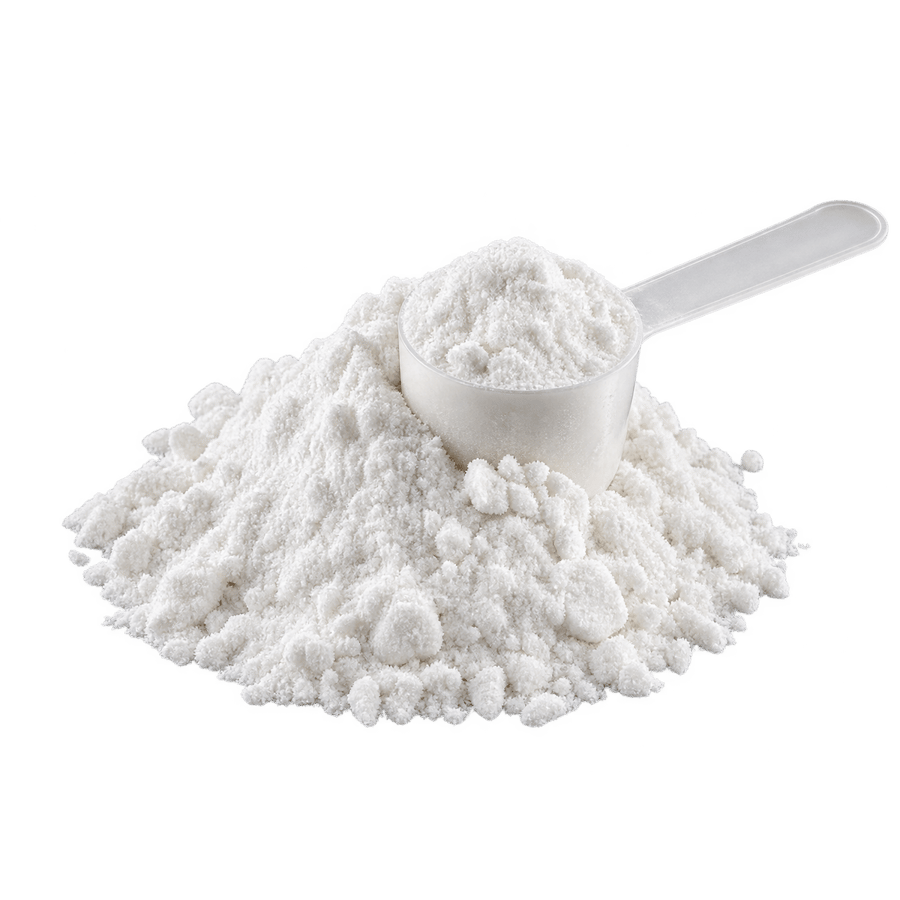
Plain creatine monohydrate powder. It’s 87.9% creatine by weight, about 99% of it is taken up by your body or passed in urine, and it’s the form nearly every trial used. HCl and the newer forms did no better. Pick an unflavored tub with a third-party test mark, and if you buy capsules or gummies, count how many make 5 g.
The creatine shelf is crowded. There are HCl versions that claim you need less, buffered versions that claim no bloating, ethyl esters, nitrates, liquids, chews and gummies, most of them at a higher price per gram than the plain powder in the plain tub. The labels make the plain stuff sound outdated.
Plain monohydrate is the creatine in the research. When a study says creatine works, this is almost always what it tested. It’s the same molecule as the creatine in meat and fish, made without animals, and if you’d rather start with food, foods high in creatine shows how far meat and fish get you.
What we’d do
Buy plain, unflavored creatine monohydrate powder with a third-party test mark on the label, and take one 5 g scoop a day. Skip HCl, buffered and the rest, since nothing shows they work better and they cost more. Capsules are fine if you don’t mind swallowing several a day. Gummies work if each one really holds what the label says, so only buy tested ones and count how many you need.
If you remember three things
- Plain monohydrate powder. It’s what the trials used and it’s 87.9% creatine.
- Look for a third-party test mark. It shows someone checked what’s inside.
- Count to 5 g. At 0.75 g a capsule, 5 g is 7 capsules a day.
It’s like premium gas in a regular car
If your car runs on regular, premium gas doesn’t make it faster. It just costs more. Creatine monohydrate already gets into your body almost completely, so a form that promises better absorption has nothing left to improve.
Why monohydrate?
It’s been the main form in research since the early 1990s. The trials that worked out the dose, how fast muscles fill and what it does to strength nearly all used it. A 2021 review lays out the chemistry. Monohydrate is creatine with one molecule of water attached, and it contains 87.9% creatine by weight, the most of any form except creatine anhydrous, which has the water removed. A 5 g scoop carries about 4.4 g of creatine. About 99% of the monohydrate you swallow is either taken up by your tissues or passed in urine.
It’s also stable. As a dry powder, monohydrate shows no sign of breaking down over years, even when stored warm.
What about creatine HCl?
It did no better in the two trials that tested it head to head. In a 2024 trial, 40 young adults lifted for 8 weeks on creatine HCl, monohydrate with a loading week, monohydrate without loading, or a placebo. All three creatine groups gained strength and muscle compared with placebo, and HCl showed no benefit over monohydrate.
In a 2025 trial, 31 handball and softball players took 5 g a day of monohydrate, HCl or a placebo for 8 weeks. There were no differences between the groups on any measure. The researchers wrote that claims of HCl’s superiority are “unfounded and misleading”.
HCl does dissolve more easily in water. But the 2021 review notes that how well creatine dissolves has no effect on how much ends up in your tissues.
And the other forms?
| Form | What it claims | What the evidence shows |
|---|---|---|
| Monohydrate | The standard | 87.9% creatine, the form in nearly every trial |
| Anhydrous | More creatine per gram | 100% creatine, the same molecule without the water |
| HCl | Better absorbed, smaller dose | No better than monohydrate in two trials |
| Ethyl ester | Gets into muscle more easily | No published paper shows more muscle creatine than monohydrate |
| Buffered | Less bloating | No published paper shows more muscle creatine than monohydrate |
| Nitrate, salts, liquids | Various | No published paper shows more muscle creatine than monohydrate at equal amounts |
Liquid creatine has a chemistry problem of its own. Creatine in solution slowly turns into creatinine, faster when it’s warm or acidic, which is why it’s mostly sold as a powder.
Powder, capsules or gummies?
Powder is the cheapest per day and the easiest to dose. One level 5 g scoop. It dissolves poorly in cold water, about 14 g per liter at room temperature, so stir a 5 g scoop into about 12 oz (350 mL) of water or a warm drink, and drink it soon.
Capsules hold the same monohydrate, just less of it at a time. At 0.75 g a capsule, 5 g is 7 capsules a day. The label tells you the grams per capsule, so divide 5 by that number and round up.
Gummies can work, if they hold what the label says. In a 2026 trial, 32 women beach volleyball players took 5 g a day of creatine as gummies or nothing for 10 weeks, and the creatine group jumped higher and changed direction faster. The researchers had their gummies independently checked first, citing “substantial variability in creatine content across commercially available gummy formulations”. If you buy gummies, buy ones with a third-party test mark, and count how many make 5 g.
The cost tool works out what a real 5 g day costs for any tub, bottle or bag, from the label numbers you type in. We don’t name products or link to shops.
What does a third-party test mark mean?
It means an outside lab tested the product for what’s on the label and for contaminants, instead of taking the maker’s word for it. The American Academy of Pediatrics lists high rates of contamination among its concerns about performance supplements. A test mark is the simplest way to know your scoop is creatine and only creatine.
Is creatine vegan?
The standard process the 2021 review describes makes monohydrate from two chemicals, sodium sarcosinate and cyanamide, so plain monohydrate doesn’t come from meat. Capsule shells and gummies may contain gelatin, so check those labels. For vegetarians and vegans, creatine is one of the more useful supplements, since you start with lower stores. How creatine works explains why.
Can’t you just eat more meat?
Not easily. A 5 g scoop holds the creatine in about 2.4 lb (1.1 kg) of raw steak, and cooking leaves less. A pound of raw beef or salmon carries about 1 to 2 g. Food can keep your stores where they are, but topping them up to full from food alone would take a lot of steak every day.
8 sources
- Antonio J and others, Common questions and misconceptions about creatine supplementation: what does the scientific evidence really show?, JISSN, 2021pmc.ncbi.nlm.nih.gov
- Kreider RB and others, International Society of Sports Nutrition position stand: safety and efficacy of creatine supplementation in exercise, sport, and medicine, JISSN, 2017pmc.ncbi.nlm.nih.gov
- Eghbali E, Arazi H, Suzuki K, Supplementing with which form of creatine (hydrochloride or monohydrate) alongside resistance training can have more impacts on anabolic/catabolic hormones, strength and body composition?, Physiological Research, 2024pmc.ncbi.nlm.nih.gov
- Londoño-Velásquez D and others, Creatine monohydrate versus creatine hydrochloride on strength and body composition in elite team-sport athletes, JISSN conference supplement, 2025pmc.ncbi.nlm.nih.gov
- Pereira F and others, Effects of creatine monohydrate gummies on performance and body composition in female beach volleyball athletes, J Funct Morphol Kinesiol, 2026pmc.ncbi.nlm.nih.gov
- Harris RC, Söderlund K, Hultman E, Elevation of creatine in resting and exercised muscle of normal subjects by creatine supplementation, Clinical Science, 1992pubmed.ncbi.nlm.nih.gov
- Purchas RW, Busboom JR, Wilkinson BH, Changes in the forms of iron and in concentrations of taurine, carnosine, coenzyme Q10, and creatine in beef longissimus muscle with cooking and simulated stomach and duodenal digestion, Meat Science, 2006pubmed.ncbi.nlm.nih.gov
- American Academy of Pediatrics, LaBotz M, Griesemer BA, Use of performance-enhancing substances, Pediatrics, 2016pubmed.ncbi.nlm.nih.gov