Do creatine gummies work?
They can, if each gummy really holds the creatine its label says. A 2026 trial of 5 g a day in gummies that had been independently checked improved athletes’ jumps and sprint turns. Its authors also pointed to “substantial variability” in creatine content across gummies on the market, so look for a third-party test mark and count how many make 5 g.
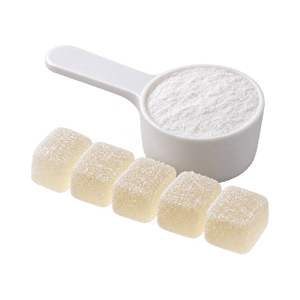
Creatine now comes as gummies. They taste like candy, they don’t need a shaker, and plenty of people who’d never buy a tub of white powder will happily eat a couple a day. The question is whether the creatine on the label is in the gummy.
What we’d do
Powder is easier to dose and it’s what the trials used, so it’s our first pick. If gummies are what you’ll actually take every day, that’s a fair trade. Buy ones with a third-party test mark, check the grams of creatine monohydrate per gummy, and take enough to reach 3 to 5 g.
The trial that worked
In 2026 Flavia Pereira and colleagues gave 32 female college and professional beach volleyball players either 5 g of creatine a day in gummies or nothing, for 10 weeks. The gummy group jumped higher and got faster at changing direction, while the control group stayed the same or got worse. The gummy group also held its body composition better over the season.
The researchers had the gummies independently checked to make sure they held the labeled amount of creatine monohydrate. They said so because of what they called recent evidence of “substantial variability” in creatine content across commercial gummies. Their control group got no placebo gummy, which the authors list as a limit, since knowing you’re on the real thing can change how hard you try.
Why content is the problem
The 2021 review of creatine questions explains that creatine slowly breaks down into creatinine once it’s dissolved, faster when it’s warm or acidic, while dry powder stays stable for years. A gummy holds moisture and a powder doesn’t, so it’s harder to be sure the creatine in a gummy stays creatine. You can’t see the difference from outside.
The American Academy of Pediatrics lists high rates of contamination among its worries about legal performance supplements in general. A test mark from an independent lab is the best way a shopper has to tell a good product from a bad one.
It’s like buying a bag of coffee that says 12 oz without a scale in the store. Most of the time it’s fine, and you’d want someone to have weighed it.

How many make 5 g
Check the label for grams of creatine monohydrate per gummy, then do the math.
| Creatine per gummy | Gummies for about 5 g |
|---|---|
| 0.75 g | 7 |
| 1 g | 5 |
| 1.5 g | 4, which gives 6 g |
| 2.5 g | 2 |
If a “serving” is two gummies but only adds up to 1.5 g, you’re well under the dose that filled muscles in the trials. In the 1996 trial behind the slow path, it took 3 g a day for 28 days.
The cost tool does this math for any product and puts its cost per day and per year next to a second product, like a tub of powder.
4 sources
- Pereira F and others, Effects of creatine monohydrate gummies on performance and body composition in female beach volleyball athletes, Journal of Functional Morphology and Kinesiology, 2026pmc.ncbi.nlm.nih.gov
- Antonio J and others, Common questions and misconceptions about creatine supplementation: what does the scientific evidence really show?, JISSN, 2021pmc.ncbi.nlm.nih.gov
- LaBotz M, Griesemer BA and the AAP Council on Sports Medicine and Fitness, Use of performance-enhancing substances, Pediatrics, 2016pubmed.ncbi.nlm.nih.gov
- Hultman E and others, Muscle creatine loading in men, J Appl Physiol, 1996pubmed.ncbi.nlm.nih.gov