Creatine benefits: how it works and who it helps most
On this page
- Your muscles are already mostly full
- Food first, if you want to
- Where the extra rep comes from
- Who gets the most out of it
- The brain is the open question
- How much: 3 to 5 g, and when more makes sense
- The worries, checked
- Teens and the new laws
- How did creatine go from meat to a tub?
- Six facts you can check
- Everything in the guide
- What’s new since our first creatine guide
- The simple plan
Creatine works, and it works through your training. Take 3 to 5 g of plain creatine monohydrate every day, and in about four weeks your muscles are full and give you a rep or two more on every hard set. If you eat little or no meat, it’s about as close to essential as a supplement gets. For nearly everyone else, it’s a cheap, safe top-up.
People hear four things about creatine. It’s a kind of steroid, it’s just water, it wrecks your kidneys, and it’s the one supplement that actually works. Then they open a tub, the scale jumps a few pounds in the first week, and they decide that was the result.
The scale goes up for everyone who takes creatine, whether it’s doing anything for their training or not, so it can’t tell you much. The real effect is smaller than the hype and more useful, and it shows up in the gym. And the people who get the most out of it are often the ones who never thought it was for them, like vegetarians and people over 50.
What we’d do
Take 3 to 5 g of plain creatine monohydrate every day, with a meal you never skip. Skip loading unless you need it working within a week, since it gets you to the same place about three weeks sooner and puts 2 to 7 lb (1 to 3 kg) of water on the scale that week. Test one lift or benchmark before your first scoop and again at week eight.
If you’re vegetarian or vegan and you train, this is the first supplement we’d buy. If you don’t do any kind of hard training, start there, since creatine has very little to work with otherwise.
If you remember three things
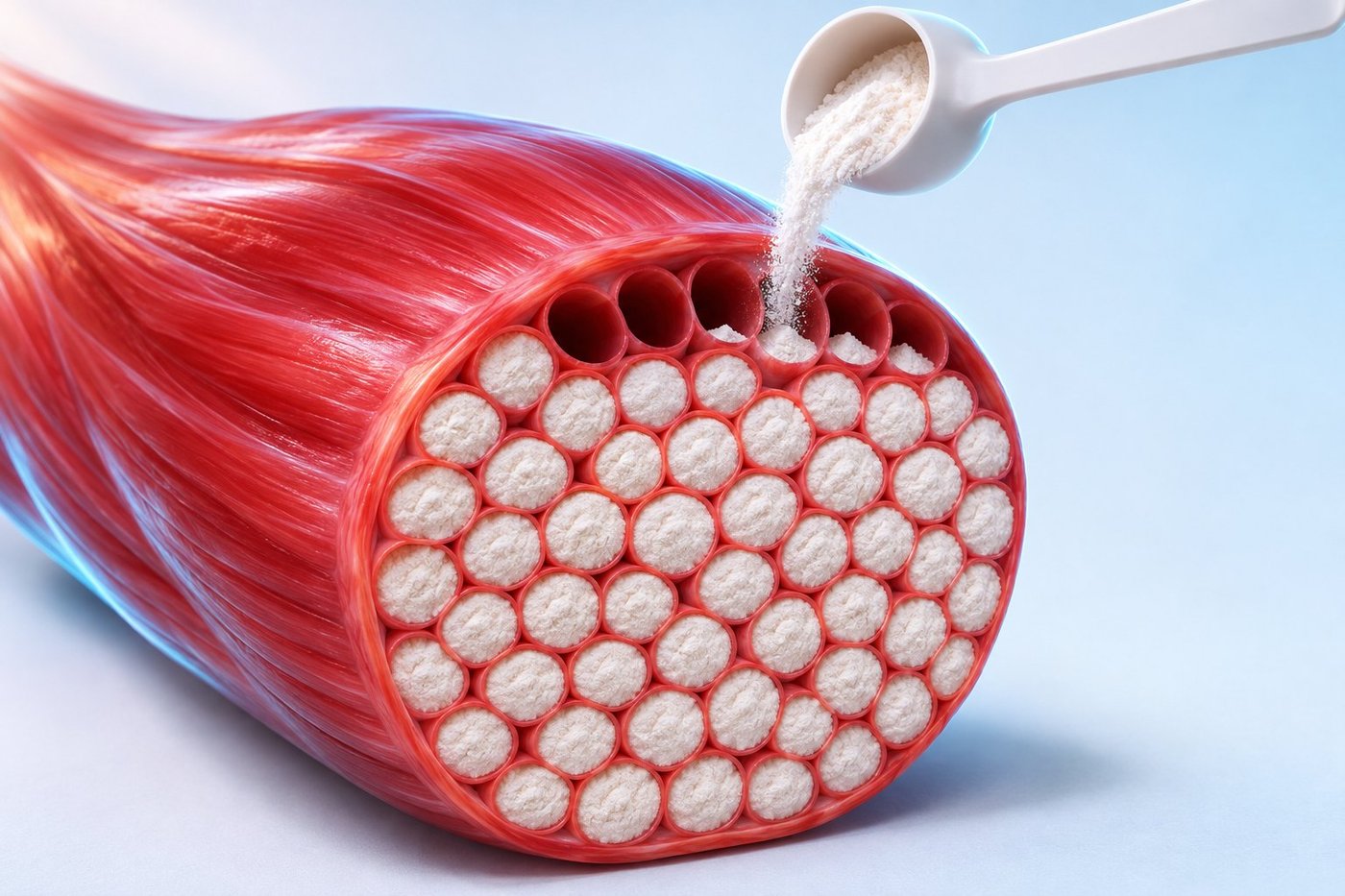
- You’re already about three quarters full. A daily scoop tops up the last quarter, and people who eat little meat have the most room to fill.
- The extra rep is the whole effect. With lifting, strength rose 20% on creatine against 12% on placebo across 22 studies.
- 3 to 5 g a day covers nearly everyone. Bigger doses have their uses, but one big serving is what upsets your stomach.
Your muscles are already mostly full
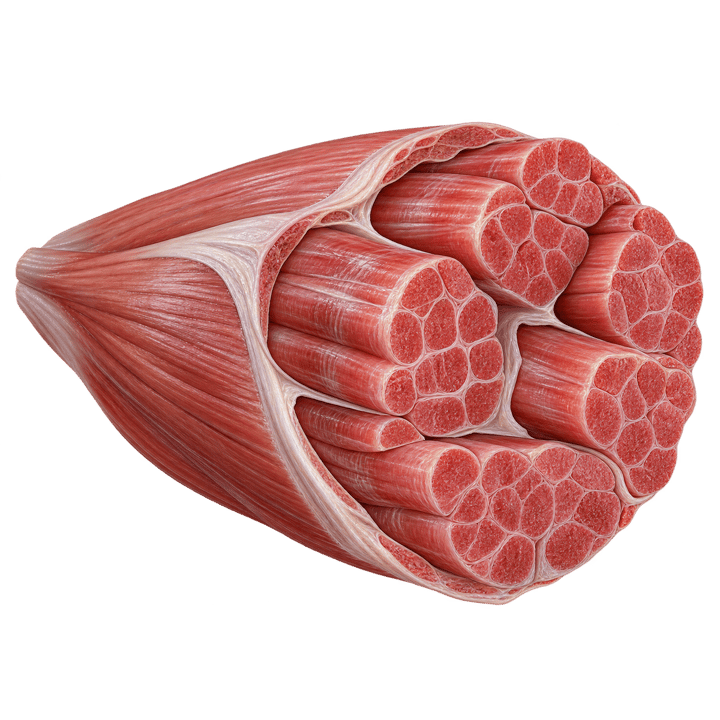
Creatine is a small molecule your body makes every day in the liver and kidneys, from two amino acids, and you also eat it in meat and fish. About 95% of it sits in your muscles, and about two thirds of that is stored as phosphocreatine, a ready-made charge for the first seconds of an all-out effort.
On a mixed diet, muscle holds about 120 mmol of creatine per kg of dry muscle, and the ceiling for most people is about 160 (ISSN 2017). So you’re already about three quarters full from food and from what your body makes. People who eat meat or fish most days start a little higher, and vegetarians and vegans start lower, at about 90 to 110.
-
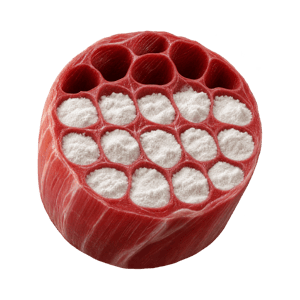 Vegetarian or vegan about two thirds about 100 of 160
- Meat a few times a week about three quarters about 120 of 160
-
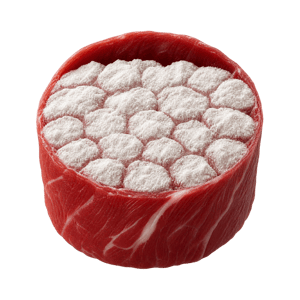 Meat or fish most days about four fifths about 130 of 160
-
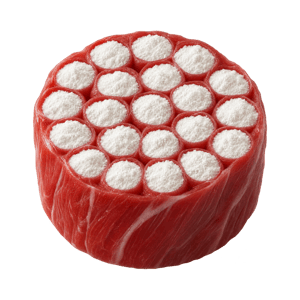 After 28 days of 3 to 5 g full about 160, the ceiling
It’s like a phone that always sits at 75%. A charger doesn’t give you a bigger battery, it fills the last quarter, and once it’s at 100% the cable does nothing. Taking more creatine than you need doesn’t make you fuller, and loading only gets you to the same ceiling sooner. How creatine works has the whole mechanism.
Food first, if you want to
Creatine is in meat and fish because it’s in muscle, and no plant food has any. Your liver and kidneys make about half of what you use each day, and food brings the rest. If you want to, and if you can, eating meat or fish most days is the natural way to keep your stores up, and it gets most people to about four fifths full.
Food is a small source next to a scoop, though. A 4 oz portion of raw beef holds about 0.44 g, the average American gets about 0.7 g a day from food, and one 5 g scoop carries 4.4 g, the creatine in about 2.4 lb of raw steak. Food keeps you topped up, and the last fifth takes a scoop. Foods high in creatine has the numbers for each meat and fish, and what cooking does.
Where the extra rep comes from
In a hard set, your muscle burns through its ATP, the fuel molecule, in seconds. Phosphocreatine rebuilds it on the spot by handing over its phosphate. Fuller stores mean more of that quick charge, and it refills faster between efforts, so you can push a little further before the set ends.
That’s a small thing on its own. But across 22 studies of creatine with weight training, strength rose 20% against 12% on placebo, and reps at the same weight rose 26% against 12%. On a set of 10, that’s about one or two more reps. Across 35 trials, lean mass rose 2.4 lb (1.1 kg) more with lifting than lifting alone, and 0.07 lb (0.03 kg), which is nothing, without exercise.
Think of it as a spotter who helps you get one more rep out of each hard set. Those extra reps, session after session for months, are what build the muscle. Creatine for muscle has the studies, the pathway step by step and a 12-week plan.
Who gets the most out of it
The rule that runs through every trial is that the people with the most room gain the most. In 2003 Burke’s team put 18 vegetarians and 24 meat eaters through the same 8-week lifting program. Phosphocreatine in the thigh rose 66% in vegetarians on creatine against 19% in meat eaters on creatine, and the vegetarians put on more lean tissue too. People in their late 50s to 70 who lifted two or three days a week gained about 3 lb (1.37 kg) more lean tissue on creatine across 22 trials.
-
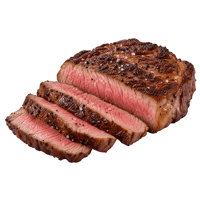 From foodMeat and fish, sized against a scoop.
-
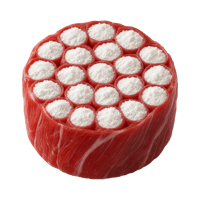 For muscleThe studies, the pathway, and a 12-week plan.
-
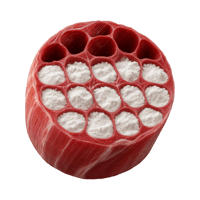 Vegetarians and vegansThe biggest gains of anyone, and the powder is vegan.
-
 For the brainSleep loss, memory and aging, and what failed to replicate.
-
 For womenThe same scoop, and what it does after menopause.
-
 After 50Where the lean tissue gains are biggest.
-
 High dosesWhat 10, 20 and 30 g a day have done in studies.
-
 Hair lossThe 2009 study, the 2025 trial, and what to do if you worry.
-
 Heat and storageWhen creatine breaks down, and the drinks that speed it up.
-
 Kidneys and blood testsWhy creatinine goes up, and the test to ask for.
-
 Teens and the lawNew York's law, California's new one, and the science.
The people who gain least are the ones who don’t train. Without exercise, lean mass didn’t move in pooled trials, and the 2026 study that found about 2 lb (1 kg) used double the usual dose in 13 people.
The brain is the open question
Your brain runs on the same quick charge as your muscles, which is why so many people now call creatine a brain supplement. The catch is getting it there. A daily dose raises brain creatine only about 5% to 10%, against 20% to 40% in muscle (Antonio 2025), because the brain makes its own and lets little in from the blood.
The results match that. Across 16 trials, memory improved slightly and overall thinking didn’t change. The clearest effect came from one large dose during a night without sleep. In 2024 the European Food Safety Authority weighed the evidence for a claim that creatine improves thinking and found that a cause and effect hadn’t been shown. Take it for your muscles and count the brain as a possible bonus. Creatine for the brain has every trial, including the ones that didn’t replicate.
How much: 3 to 5 g, and when more makes sense
For almost everyone, 3 to 5 g a day keeps muscle full once it’s there. Loading is about 0.3 g per kg a day for six days, which is 24 g at 176 lb, and we cap it at 25 g. The International Society of Sports Nutrition says larger athletes in hard training may need 5 to 10 g a day, and brain and medical studies have used 20 g and more.
More has a cost, though. In a 28-day trial of 59 soccer players, one 10 g dose a day gave 55.6% of them diarrhea, against 28.6% on two 5 g doses and 35% on placebo. High-dose creatine has the whole scale, from 1 g to 40 g, and our dose tool gives you your dates.
The worries, checked
Kidneys. Creatine raises creatinine, the number most kidney tests are worked out from, by about 0.14 mg/dL across 26 trials. Filtering measured directly didn’t drop. If you have kidney disease, ask your doctor first. Is creatine safe? goes through every side effect.
Hair. The fear comes from a 2009 study of 20 rugby players that measured a hormone and never looked at hair. A 2025 trial measured hair for 12 weeks and found no difference. Creatine and hair loss has the pros, the cons and what to do if your hair is thinning.
Heat. Dry powder showed no breakdown after more than 3 years stored at 104°F (40°C). Once it’s mixed into a drink it slowly turns into creatinine, faster when the drink is warm or acidic, so mix it and drink it. Creatine and heat has the measured rates and where your drink sits.
Teens and the new laws
New York has barred selling supplements marketed for muscle building to anyone under 18 since April 22, 2024. California’s AB 2030, signed September 28, 2026, does the same from January 1, 2027, and both laws list creatine among the things that can put a product in that group. Creatine and the law has what each law covers, and can teens take creatine? has the science, where pediatricians and sports nutrition researchers disagree. We don’t give a dose to anyone under 18.
How did creatine go from meat to a tub?
In 1832 the French chemist Michel Eugène Chevreul pulled a new substance out of skeletal muscle, and its name comes from kreas, the Greek word for meat. In the early 1900s, animal studies showed that feeding creatine could raise the amount in muscle by as much as 70%.
The human story starts in 1992. Harris, Söderlund and Hultman, at the Karolinska Institute in Sweden, gave 17 people 5 g of creatine four or six times a day and took needle samples from their thigh muscle. Muscle creatine went up, by as much as 50% in the people who started lowest. Along the way they worked out that one 5 g dose holds the creatine in about 2.4 lb (1.1 kg) of raw steak. The early trials served it dissolved in hot tea, because creatine dissolves much better hot.
In 1996 Hultman’s group gave 31 men either 20 g a day for 6 days or 3 g a day for 28 days. Both ended at the same 20% rise in muscle creatine. Thirty days after the men stopped, their muscles were back where they started. The two dose paths and the full-by dates in our dose tool come from that trial. Since creatine became a popular supplement in the early 1990s, more than 1,000 studies have been run on it.
Six facts you can check
20%either way
20 g a day for 6 days and 3 g a day for 28 days raised muscle creatine by about the same 20%. Loading only gets you there about three weeks sooner.
1 to 3 kgin a loading week
A loading week of about 20 g a day typically puts 1 to 3 kg (2 to 7 lb) on the scale, mostly water that travels into muscle with the creatine.
87.9%creatine by weight
Plain creatine monohydrate is 87.9% creatine, the highest of any form except anhydrous, so a 5 g scoop carries about 4.4 g.
2.4 lbof raw steak
A 5 g scoop holds the creatine in about 1.1 kg (2.4 lb) of raw steak. Cooking leaves less.
0.14mg/dL of creatinine
Across 26 trials, creatine raised creatinine, the number a kidney test uses, by about 0.14 mg/dL. Kidney filtering measured directly didn't drop.

12 weeksof hair, measured
A 2025 trial gave men who lift 5 g a day or a placebo for 12 weeks, measured their hair, and found no difference. The 2009 study behind the fear never looked at hair.
Everything in the guide
What’s new since our first creatine guide
These are the findings that have changed since Gyroscope’s first creatine guide.
- More water, and a clearer number for it. The 2003 trial that measured body water in lifters found 1.37 L more in the first week of loading and 2.04 L more by day 28.
- No change in testosterone. The 2025 trial that measured hormones for 12 weeks found no difference in testosterone or DHT between creatine and placebo.
- Monohydrate is 87.9% creatine by weight, so a 5 g scoop carries about 4.4 g.
- Loading takes 5 to 7 days, at about 20 g a day.
- HCl did no better than monohydrate in two head-to-head trials, in 2024 and 2025.
- Big athletes may need more. The International Society of Sports Nutrition says larger athletes in hard training may need 5 to 10 g a day to keep stores full.
- Mood is a weak reason to take it. Across 11 trials, the effect on depression scores was 2.2 points, below the 3 points people notice, and the evidence was rated very low.
- Teens now face age checks. New York’s law took effect in 2024, and California’s starts in 2027.
The simple plan
If you want to get stronger and you’re thinking about creatine, this is how we’d do it.
- Get it from food first, if you want to and can. Meat or fish most days keeps your stores at about four fifths full. Foods high in creatine has how much each one brings. If you don’t eat meat or fish, food brings none, and a scoop does more for you than for anyone.
- Train. Lift two or three days a week, since creatine works through training and does very little without it. Creatine for muscle has a 12-week plan.
- Check it’s for you. If you’re under 18, pregnant or breastfeeding, or have kidney disease, stop here and ask your doctor. Can teens take creatine? has resources for younger readers.
- Take 3 to 5 g of plain monohydrate a day. Take it with a meal you never skip, rest days too, and skip loading unless you need it working within a week. The dose calculator gives you the day you’re full, and the best creatine to buy covers the tub.
- Test before your first scoop. Do push-ups, a dead hang or a plank twice in your first week, a few days apart, and keep the better result. Prove it worked sets your retest date.
- Log it. Note each scoop, and weigh in on the same morning each week. The scale may rise a few pounds in the first month, and that’s water. What the scale will do shows your band.
Track it in Gyroscope
Photograph your tub in Gyroscope One's Supplement mode and it logs the dose when the serving is clear, and creatine gets its own trend. See Gyroscope One, or see how tracking creatine works.
- Retest at week eight and decide. If your result beat the gap between your two first tries, it worked, so keep going. If it didn’t and you trained, that’s a fair result too, and stopping is fine. Either way, tell whoever orders your next blood test that you take creatine. The creatinine check explains why.
The quiz puts these steps together for you in eight taps, and every study and tip on this site is in one list, each a line long, to pass on.
23 sources
- Hultman E and others, Muscle creatine loading in men, J Appl Physiol, 1996pubmed.ncbi.nlm.nih.gov
- Harris RC, Söderlund K, Hultman E, Elevation of creatine in resting and exercised muscle of normal subjects by creatine supplementation, Clinical Science, 1992pubmed.ncbi.nlm.nih.gov
- Kreider RB and others, International Society of Sports Nutrition position stand: safety and efficacy of creatine supplementation in exercise, sport, and medicine, JISSN, 2017pmc.ncbi.nlm.nih.gov
- Antonio J and others, Common questions and misconceptions about creatine supplementation: what does the scientific evidence really show?, JISSN, 2021pmc.ncbi.nlm.nih.gov
- Antonio J and others, Part II. Common questions and misconceptions about creatine supplementation: what does the scientific evidence really show?, JISSN, 2025pmc.ncbi.nlm.nih.gov
- Powers ME and others, Creatine supplementation increases total body water without altering fluid distribution, Journal of Athletic Training, 2003pmc.ncbi.nlm.nih.gov
- Rawson ES, Volek JS, Effects of creatine supplementation and resistance training on muscle strength and weightlifting performance, J Strength Cond Res, 2003pubmed.ncbi.nlm.nih.gov
- Delpino FM and others, Influence of age, sex, and type of exercise on the efficacy of creatine supplementation on lean body mass, Nutrition, 2022pubmed.ncbi.nlm.nih.gov
- Chun J and others, Effects of creatine supplementation with and without exercise and diet intervention on body composition, cognitive function, and markers of health in middle-aged and older adults, JISSN, 2026doi.org
- Chilibeck PD and others, Effect of creatine supplementation during resistance training on lean tissue mass and muscular strength in older adults: a meta-analysis, Open Access Journal of Sports Medicine, 2017pmc.ncbi.nlm.nih.gov
- Burke DG and others, Effect of creatine and weight training on muscle creatine and performance in vegetarians, Medicine and Science in Sports and Exercise, 2003pubmed.ncbi.nlm.nih.gov
- Kaviani M, Shaw K and Chilibeck PD, Benefits of creatine supplementation for vegetarians compared to omnivorous athletes: a systematic review, IJERPH, 2020pmc.ncbi.nlm.nih.gov
- Xu C and others, The effects of creatine supplementation on cognitive function in adults: a systematic review and meta-analysis, Frontiers in Nutrition, 2024pmc.ncbi.nlm.nih.gov
- EFSA Panel on Nutrition, Novel Foods and Food Allergens, Creatine and improvement in cognitive function: evaluation of a health claim, EFSA Journal, 2024pmc.ncbi.nlm.nih.gov
- de Souza Almeida A and others, Impact of creatine supplementation on kidney health: a systematic review and meta-analysis, International Urology and Nephrology, 2026pubmed.ncbi.nlm.nih.gov
- Lak M and others, Does creatine cause hair loss? A 12-week randomized controlled trial, JISSN, 2025pmc.ncbi.nlm.nih.gov
- Ostojic SM, Ahmetovic Z, Gastrointestinal distress after creatine supplementation in athletes: are side effects dose dependent?, Research in Sports Medicine, 2008pubmed.ncbi.nlm.nih.gov
- Jäger R and others, Analysis of the efficacy, safety, and regulatory status of novel forms of creatine, Amino Acids, 2011pmc.ncbi.nlm.nih.gov
- Eckert I, Lima J, Dariva AA, Creatine supplementation for treating symptoms of depression: a systematic review and meta-analysis, British Journal of Nutrition, 2025pubmed.ncbi.nlm.nih.gov
- Eghbali E, Arazi H, Suzuki K, Supplementing with which form of creatine (hydrochloride or monohydrate) alongside resistance training can have more impacts on anabolic/catabolic hormones, strength and body composition?, Physiological Research, 2024pmc.ncbi.nlm.nih.gov
- Londoño-Velásquez D and others, Creatine monohydrate versus creatine hydrochloride on strength and body composition in elite team-sport athletes, JISSN conference supplement, 2025pmc.ncbi.nlm.nih.gov
- New York General Business Law section 391-oonysenate.gov
- California AB 2030 (Lowenthal), Chapter 720, Statutes of 2026, chaptered text and history as published by CalMatters Digital Democracycalmatters.digitaldemocracy.org