How much to take, and loading
On this page
3 to 5 g of creatine monohydrate a day, every day, rest days too. Loading is optional. It means about 0.3 g per kg of body weight (0.14 g per lb) a day for 6 days, capped at 25 g and split into four servings. It fills your muscles about three weeks sooner and ends at exactly the same level.
Ask around and you’ll get four different answers. Some calculators multiply your weight by 0.03 g, which gives 2.4 g at 180 lb. Others say 5 g for everyone. Plenty of tubs print a loading week of 20 g a day. And heavier people tend to assume they need more, because that’s how most things are dosed.
The trials behind creatine used flat amounts, and they set a clear range. The only real decision is whether you want your muscles full in about a week or about a month.
What we’d do
Take 3 to 5 g every day, with a meal you never skip, and count from the day your stores are full instead of your first scoop. Skip loading unless you need creatine working within a week, for a race, a test or a new program. Loading puts 2 to 7 lb (1 to 3 kg) of water on the scale that week and is the one time creatine tends to upset stomachs. If you weigh 220 lb (100 kg) or more and train hard four or more days a week, you can go up to 10 g, split in two, but 5 g is a fine place to start.
If you remember three things
- 3 to 5 g a day fills your muscles in about four weeks. Loading gets there in about six days.
- Both end at the same level. 20 g a day and 3 g a day both raised muscle creatine by about 20%.
- Keep every serving at 10 g or under. One big dose is what upsets stomachs.
Why doesn’t the dose go up with your weight?
Because the trials that set it used flat amounts. In 1996, Hultman’s group gave 31 men either 20 g a day for 6 days or 3 g a day for 28 days, and both groups ended at the same 20% rise in muscle creatine. Nobody’s 3 g was adjusted for body weight.
The International Society of Sports Nutrition says 3 to 5 g a day keeps stores full for most people, and that larger athletes in hard training may need as much as 5 to 10 g. A 2021 review gave 3 to 5 g, or 0.1 g per kg, which comes to about 8 g for a 176 lb (80 kg) person. Both point the same way. A body with more muscle breaks down more creatine each day, so it may need a bit more to stay full.
The 0.03 g per kg rule some calculators use is smaller than the trials’ usual dose. It does do something. In a 2011 trial, about 2.3 g a day for 6 weeks made 20 young adults 7 to 11% more resistant to fatigue, with no change on the scale. But nobody has timed how long it takes to fill your stores at that dose, so we stick to the range the fill trials used.
Picture a bathtub
Fill a bathtub with the tap on full or on a trickle. It’s the same tub, and the water stops at the same line. The full tap just gets there sooner, and splashes more. Once the tub is full, anything extra goes down the overflow. Your muscles work the same way. Once they’re full, the extra creatine leaves in your urine.
When will your muscles be full?
If you start on Monday, November 16, loading fills your muscles by the end of Saturday, November 21. On 3 to 5 g a day, they’re full by Sunday, December 13. The dose tool gives you your own dates.
Those two days, 6 and 28, are the measured ones. Hultman’s slow arm took 3 g a day, so 5 g may get there a few days sooner, but no trial has timed it. We draw the curve between the measured days, and the true shape in between hasn’t been measured.
How do you load, if you do?
Take about 0.3 g per kg of body weight a day for 6 days, in four even servings, then drop to 3 to 5 g. We cap it at 25 g a day, the top dose in the loading trials we cite, and 0.3 g per kg reaches that at about 183 lb (83 kg).
| Your weight | Loading, each day for 6 days | Each of 4 servings | Then every day |
|---|---|---|---|
| 120 lb (54 kg) | 16 g | 4 g | 3 to 5 g |
| 140 lb (64 kg) | 19 g | about 5 g | 3 to 5 g |
| 160 lb (73 kg) | 22 g | 5.5 g | 3 to 5 g |
| 180 lb (82 kg) | 24 g | 6 g | 3 to 5 g |
| 200 lb (91 kg) | 25 g, the cap | about 6 g | 3 to 5 g |
| 220 lb (100 kg) and up | 25 g, the cap | about 6 g | 3 to 5 g, up to 10 g for big athletes in hard training |
Splitting the day is what keeps your stomach calm. In a 2008 trial, 59 soccer players took creatine for 28 days. On one 10 g dose a day, 56% had diarrhea. On two 5 g doses, 29% did, which was no worse than the 35% on placebo. A 2021 review advises keeping every serving at 10 g or under.
When does loading make sense?
Load if you need creatine working within a week or two, say for a competition, a strength test or the start of a new program. Skip it in these cases:
- You weigh in every day, or have a weigh-in coming. The water shows up that week. What the scale will do has the numbers.
- You have a blood test coming. Creatine raises creatinine, and a week of big doses is a bad time for a kidney check.
- You’re losing weight. The water can hide two to four weeks of fat loss on the scale.
- Your stomach is sensitive, or you’re on a GLP-1 drug. Big doses are what cause stomach trouble.
Should you take it on rest days?
Yes, the same dose. About 1 to 2% of your muscle creatine breaks down every day whether you train or not, so rest days use it up too. Taking it every day keeps the level steady.
When should you take it?
Whenever you’ll remember. A small 2013 trial of 19 bodybuilders found a slight edge for taking it right after training instead of right before, but the difference wasn’t statistically significant by the usual tests. What fills your muscles is the daily total. Taking it with a meal helps a little, since creatine taken with carbohydrate and protein is retained better, though that hasn’t been shown to improve performance. The timing myth has the details.
What if you miss a day?
Take your usual dose the next day and carry on. Don’t double up. Your stores fall slowly when you stop, taking about a month to drift back to where they started, so one missed day barely moves them.
How do you mix it?
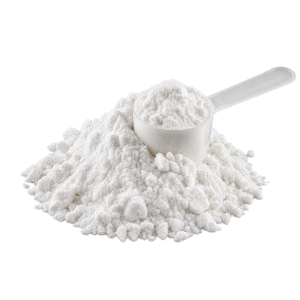
Plain monohydrate dissolves poorly in cold water, about 14 g per liter at room temperature, so a 5 g scoop needs about 12 oz (350 mL) of water to dissolve fully. Warm drinks dissolve more, which is why the first trials served it in hot tea. Drink it soon after mixing, because creatine slowly turns into creatinine in liquid, faster when it’s warm or acidic. As a dry powder it keeps for years.
Who shouldn’t take it without a doctor?
We don’t give a dose to anyone under 18. The American Academy of Pediatrics strongly opposes performance supplements for children and teens. If you’re pregnant or breastfeeding, or have kidney disease, there isn’t enough research to give you a dose, so ask your doctor first. Is creatine safe? covers each case.
10 sources
- Hultman E and others, Muscle creatine loading in men, J Appl Physiol, 1996pubmed.ncbi.nlm.nih.gov
- Kreider RB and others, International Society of Sports Nutrition position stand: safety and efficacy of creatine supplementation in exercise, sport, and medicine, JISSN, 2017pmc.ncbi.nlm.nih.gov
- Antonio J and others, Common questions and misconceptions about creatine supplementation: what does the scientific evidence really show?, JISSN, 2021pmc.ncbi.nlm.nih.gov
- Harris RC, Söderlund K, Hultman E, Elevation of creatine in resting and exercised muscle of normal subjects by creatine supplementation, Clinical Science, 1992pubmed.ncbi.nlm.nih.gov
- Rawson ES and others, Low-dose creatine supplementation enhances fatigue resistance in the absence of weight gain, Nutrition, 2011pubmed.ncbi.nlm.nih.gov
- Ostojic SM, Ahmetovic Z, Gastrointestinal distress after creatine supplementation in athletes: are side effects dose dependent?, Research in Sports Medicine, 2008pubmed.ncbi.nlm.nih.gov
- Antonio J, Ciccone V, The effects of pre versus post workout supplementation of creatine monohydrate on body composition and strength, JISSN, 2013pmc.ncbi.nlm.nih.gov
- de Souza Almeida A and others, Impact of creatine supplementation on kidney health: a systematic review and meta-analysis, International Urology and Nephrology, 2026pubmed.ncbi.nlm.nih.gov
- Powers ME and others, Creatine supplementation increases total body water without altering fluid distribution, Journal of Athletic Training, 2003pmc.ncbi.nlm.nih.gov
- American Academy of Pediatrics, Gomez J, Use of performance-enhancing substances, Pediatrics, 2005pubmed.ncbi.nlm.nih.gov