High-dose creatine: how much is too much?
On this page
For most people, anything past 5 g a day mostly leaves in your urine once your muscles are full. There are real reasons to take more, like a loading week, a big body in hard training, or a research study, and doses up to 30 g a day for years haven’t shown harm in the trials that tested them. The limit you’ll hit first is your stomach, so never take more than 10 g at once, and split anything over 5 g.
High-dose creatine is having a moment. Some people double or triple their scoop on the idea that if 5 g works, 15 g must work better. Others hear about 20 g brain studies and want in. And a lot of people are nervous about going one gram over the label, because they’ve heard creatine is hard on the kidneys. The trials answer both groups, and the answers are less dramatic than either side expects.
What we’d do
Stay at 3 to 5 g a day unless you have a reason. If you’re over 220 lb and training hard four or more days a week, going up to 10 g a day is reasonable, split into two servings with meals. Load only if you need it working within a week. Save 20 g and up for a study or your doctor’s advice.
What “high dose” means in studies
Researchers have given creatine at almost every dose from 1 g to 40 g a day. Here’s the whole range for one adult, and what each dose was for.
- 1 g a day Enough to stop a new vegetarian's stores falling (Blancquaert 2018)
- 3 g a day Fills muscle in 28 days (Hultman 1996)
- 3 to 5 g a dayfor years The everyday dose, for good (ISSN 2017)
- 0.1 g per kg, 8 g Another way to dose in a 2021 review
- 10 g a dayfor years The top of the range for larger athletes in hard training (ISSN), and a Parkinson's trial of 1,741 people planned for 5 years
- 20 g a day An 8-week Alzheimer's pilot that raised brain creatine 11%
- 0.3 g per kg, 24 g Loading, 6 days only, in four servings
- 0.35 g per kg, 28 g once One dose during a night without sleep
- Up to 30 g a dayfor years Patients in medical studies, for up to 5 years
- Up to 40 g a dayfor years A Huntington's trial of up to 48 months, with more stomach side effects on creatine
Most of these high doses were taken for a short time or by people with a disease, under a doctor’s eye. Healthy gym users taking 20 g or more every day for years haven’t been studied.
Why more mostly ends up in your urine
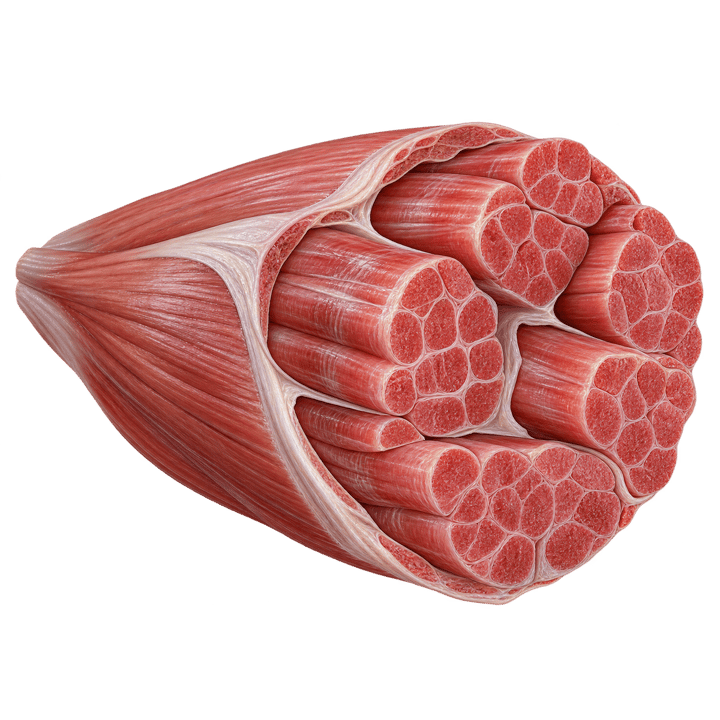
Your muscles have a ceiling, at about 160 mmol of creatine per kg of dry muscle for most people (ISSN 2017). Once they’re full, extra creatine doesn’t push the ceiling higher. In the 1992 study that started the creatine era, three people taking 30 g a day passed 40% to 68% of it in their urine in the first three days. And in 1996, 20 g a day for six days and 3 g a day for 28 days ended at the same 20% rise in muscle creatine.
It’s like pouring water into a glass that’s already full. A bigger jug doesn’t give you more water in the glass, it just spills faster.
When more makes sense
A loading week. About 0.3 g per kg a day for 5 to 7 days fills your muscles in about a week instead of a month (ISSN 2017). At 176 lb that’s 24 g a day, and we cap it at 25 g. It’s the most common high dose, and it’s short.
A big body in hard training. The International Society of Sports Nutrition says larger athletes in hard training may need 5 to 10 g a day to keep their stores full. A 2021 review offers 0.1 g per kg a day as another way to dose, which is 8 g at 176 lb. Our dose tool shows this line from 220 lb with four or more training days a week, and still starts you at 5 g.
The brain. The brain takes up creatine slowly, and the studies that raised brain creatine most used about 20 g a day, or a single dose of 0.35 g per kg. Lower doses may get there over months (Antonio 2025). Creatine for the brain covers what those doses did.
Medicine. Patients in medical studies have taken 0.3 to 0.8 g per kg a day, 21 to 56 g at 154 lb, for years, with no serious problems reported (ISSN 2017). Those were trials with doctors watching, for conditions where creatine was being tested as a treatment.
What the safety evidence shows
The International Society of Sports Nutrition found no compelling evidence that up to 30 g a day for 5 years harms healthy people or patients. A few trials looked closely at higher doses:
- 10 g a day for 3 months. In 18 healthy young men, cystatin C, a kidney marker that muscle barely affects, fell slightly in both the creatine and placebo groups (Gualano 2008).
- 10 g a day for 12 weeks. In 64 adults aged 45 to 65, taken as two 5 g servings, the authors reported it was well tolerated (Chun 2026).
- 10 g a day in Parkinson’s. 1,741 people were enrolled to take creatine or placebo for at least 5 years. The trial was stopped early because creatine didn’t slow the disease (NET-PD 2015).
- Up to 40 g a day in Huntington’s. 553 people for up to 48 months. Stomach side effects were more common on creatine, and serious problems, deaths included, were more common on placebo. Creatine didn’t slow the disease (Hersch 2017).
A higher dose does raise creatinine on a blood test, because fuller muscles break down more creatine into creatinine. At the usual doses the rise was about 0.14 mg/dL across 26 trials, while kidney filtering measured directly didn’t drop. Tell whoever orders your blood work how much you take. Why did my creatinine go up? covers what to ask for.
The stomach is the real limit
The clearest dose trial is about diarrhea. In 2008, 59 top-level soccer players took creatine for 28 days as two 5 g doses a day, one 10 g dose a day, or a placebo.
- Two 5 g doses a day
- One 10 g dose a day
- Placebo
Two 5 g doses were no worse than placebo. The single 10 g dose was. A 2021 review of creatine questions gives the same advice for loading weeks, which is to keep each serving at 10 g or under (Antonio 2021). Your stomach cares more about the size of each serving than the total for the day.
Who should not take high doses
Skip high doses, and ask your doctor before any dose, if you have kidney disease, or diabetes or high blood pressure that has affected your kidneys (Longobardi 2025), or if you’re pregnant or breastfeeding. We don’t give a dose to anyone under 18. If you have bipolar disorder, read the brain page first, since two people in a small bipolar trial had a manic episode on creatine.
The protocol
How to go above 5 g a day, if you have a reason to.
- Start at 3 to 5 g a day. That fills almost everyone’s muscles within about four weeks.
- Go to 10 g only if you’re big and train hard. Over 220 lb with four or more hard days a week, take two 5 g servings with two meals.
- Load only when you need it fast. 0.3 g per kg for 6 days, capped at 25 g, in four servings. At 176 lb that’s about 6 g four times a day, then back to 3 to 5 g.
- Never take more than 10 g at once. Split anything over 5 g a day across meals, and back off if your stomach complains.
- Tell your doctor before blood work. More creatine means a higher creatinine, and a cystatin C test isn’t thrown off by it.
- Keep 20 g and up for research or medical care. Those doses have been tested for weeks in healthy people and for years only in patients with doctors watching.
15 sources
- Kreider RB and others, International Society of Sports Nutrition position stand: safety and efficacy of creatine supplementation in exercise, sport, and medicine, JISSN, 2017pmc.ncbi.nlm.nih.gov
- Antonio J and others, Common questions and misconceptions about creatine supplementation: what does the scientific evidence really show?, JISSN, 2021pmc.ncbi.nlm.nih.gov
- Antonio J and others, Part II. Common questions and misconceptions about creatine supplementation: what does the scientific evidence really show?, JISSN, 2025pmc.ncbi.nlm.nih.gov
- Hultman E and others, Muscle creatine loading in men, J Appl Physiol, 1996pubmed.ncbi.nlm.nih.gov
- Harris RC, Söderlund K, Hultman E, Elevation of creatine in resting and exercised muscle of normal subjects by creatine supplementation, Clinical Science, 1992pubmed.ncbi.nlm.nih.gov
- Ostojic SM, Ahmetovic Z, Gastrointestinal distress after creatine supplementation in athletes: are side effects dose dependent?, Research in Sports Medicine, 2008pubmed.ncbi.nlm.nih.gov
- Gualano B and others, Effects of creatine supplementation on renal function: a randomized, double-blind, placebo-controlled clinical trial, European Journal of Applied Physiology, 2008pubmed.ncbi.nlm.nih.gov
- Chun J and others, Effects of creatine supplementation with and without exercise and diet intervention on body composition, cognitive function, and markers of health in middle-aged and older adults, JISSN, 2026doi.org
- Hersch SM and others, The CREST-E study of creatine for Huntington disease: a randomized controlled trial, Neurology, 2017pmc.ncbi.nlm.nih.gov
- Writing Group for the NINDS Exploratory Trials in Parkinson Disease Investigators, Effect of creatine monohydrate on clinical progression in patients with Parkinson disease: a randomized clinical trial, JAMA, 2015pmc.ncbi.nlm.nih.gov
- Smith AN and others, Creatine monohydrate pilot in Alzheimer's: feasibility, brain creatine, and cognition, Alzheimer's and Dementia: Translational Research and Clinical Interventions, 2025pmc.ncbi.nlm.nih.gov
- Gordji-Nejad A and others, Single dose creatine improves cognitive performance and induces changes in cerebral high energy phosphates during sleep deprivation, Scientific Reports, 2024pmc.ncbi.nlm.nih.gov
- Blancquaert L and others, Changing to a vegetarian diet reduces the body creatine pool in omnivorous women, British Journal of Nutrition, 2018pubmed.ncbi.nlm.nih.gov
- Longobardi I and others, A short review of the most common safety concerns regarding creatine ingestion, Frontiers in Nutrition, 2025pmc.ncbi.nlm.nih.gov
- de Souza Almeida A and others, Impact of creatine supplementation on kidney health: a systematic review and meta-analysis, International Urology and Nephrology, 2026pubmed.ncbi.nlm.nih.gov