How creatine works
On this page
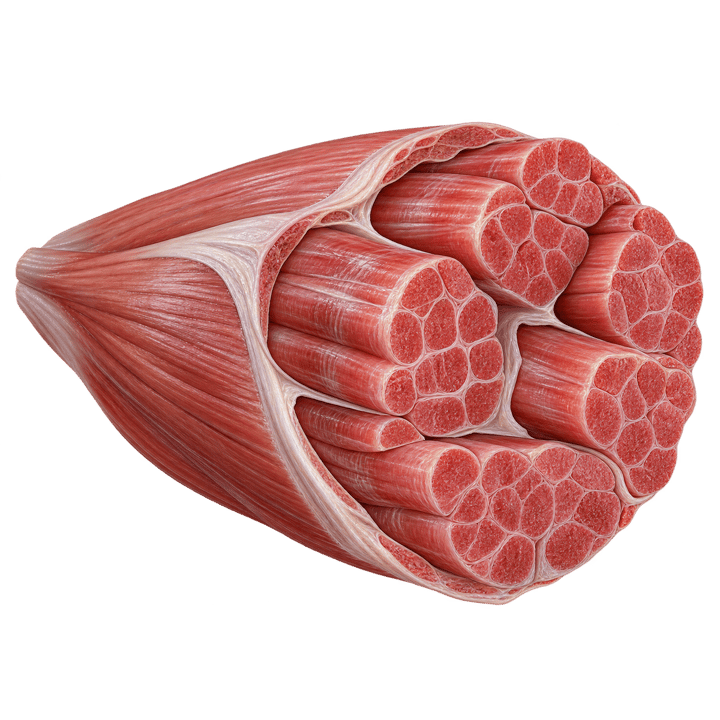
Creatine is a spare charge for your muscles. About 95% of it sits in muscle, mostly as phosphocreatine, which rebuilds the energy a muscle burns in the first seconds of an all-out effort. You’re already about three quarters full from food and from what your body makes, and a daily scoop tops you up by 20 to 40%.
Most people think of creatine as a muscle builder in a tub, like a stronger protein powder or a mild hormone. That picture is why it gets called a steroid, and why people expect to feel something on day one.
The real job is smaller and more mechanical. Creatine refills the fastest energy your muscles have, so you can push a little harder before a hard set falls apart. Any muscle you build comes from that extra work, over months.
What we’d do
Take creatine for what it does, which is a bit more work in the hardest sets of a lifting program. Expect nothing you can feel on day one, since your stores take days to weeks to fill. If you don’t lift or train hard, creatine has almost nothing to work with, so start the training first.
If you remember three things
- Creatine refills your fastest energy. It helps most in hard efforts that last seconds, like a heavy set or a sprint.
- You already have most of it. On a mixed diet your muscles hold about three quarters of what they can.
- The muscle comes from the extra work. Without lifting, lean mass didn’t move across 35 trials.
Where does creatine come from?
Your body makes it. The liver and kidneys build creatine from two amino acids, arginine and glycine, and send it out in the blood to your muscles, brain and other tissues. About 95% ends up in skeletal muscle, and most of the rest in the brain and testes.
You also eat it. Creatine is found mostly in red meat and seafood, and a pound of raw beef or salmon carries about 1 to 2 g. If you eat meat, about half of the creatine you use each day comes from food and the rest you make yourself.
You use it up steadily. About 1 to 2% of the creatine in your muscles breaks down every day into creatinine, a waste product your kidneys pass into urine. To stay level, you need to replace about 1 to 3 g a day, depending on how much muscle you carry. That daily breakdown is also why creatine shows up on a blood test, which the safety section explains.
Why do vegetarians start lower?
Creatine in food comes mainly from red meat and seafood, so vegetarians and vegans rely mostly on what their own bodies make. Their muscles hold about 90 to 110 mmol of creatine per kg of dry muscle, against about 120 on a mixed diet.
In a 2003 trial, Burke’s group took muscle samples from 18 vegetarians and 24 meat eaters before 8 weeks of the same lifting program. The vegetarians started at 117 and the meat eaters at 130. The vegetarians who took creatine gained more stored creatine, more lean tissue and more total work than the meat eaters who took it. Do vegetarians get more from creatine? has more.
Think of it as cash in your back pocket
ATP is the cash in the till. Every muscle contraction spends it, and the till only holds a few seconds’ worth. Phosphocreatine is the cash in your back pocket. It refills the till instantly, while the slower systems are still on their way from the bank. Creatine gives you a slightly fatter back pocket, so the till stays full a little longer when you’re spending fast.
What happens inside a hard set?
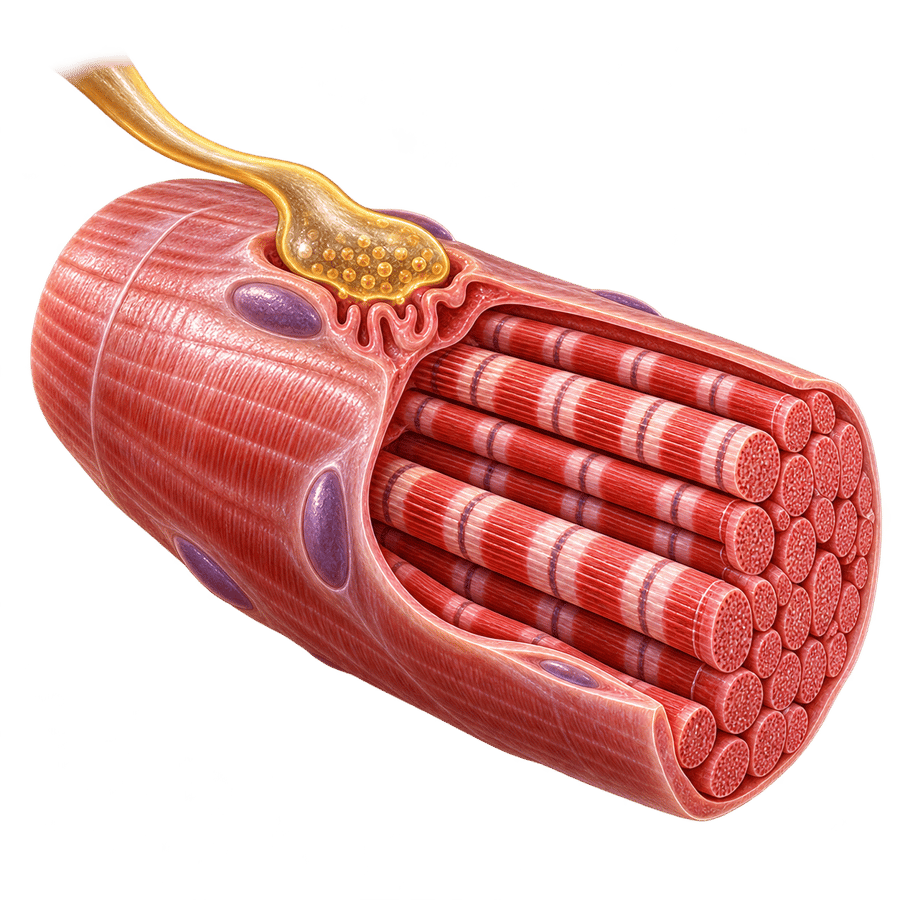
- A muscle contracts by breaking down ATP, the molecule every cell spends for energy. A muscle keeps only a small amount on hand.
- During an all-out effort, phosphocreatine hands its phosphate back to rebuild ATP right away, through an enzyme called creatine kinase. About two thirds of the creatine in your muscle is stored this way, charged and ready.
- As phosphocreatine runs low, the slower systems that burn sugar and fat have to carry more of the load, and the effort slows down. On a heavy set, that’s the rep where the bar stops moving.
- With fuller creatine stores, there’s more phosphocreatine to draw on, so you get a little more out of the effort before it fades.
- Over weeks of training, those extra reps add up to more total work, and more work is what builds strength and muscle.
The model is clearest for short, hard efforts. The trials that pooled creatine’s strength effect only counted efforts lasting under three minutes. Creatine also helps carry energy from the mitochondria, the cell’s slower power plants, to where it’s used, and it may help muscles store more glycogen. Those effects are real chemistry but far less tested, and they aren’t the reason to take it.
How full can your muscles get?
The ceiling for most people is about 160 mmol per kg of dry muscle. On a normal diet that gives 1 to 2 g of creatine a day, muscle stores are about 60 to 80% full, so a supplement can raise them by about 20 to 40%.
The people who start lowest gain the most. In the 1992 trial that first showed creatine supplements could fill human muscle, some volunteers rose as much as 50%, and those were the ones who started low. In 1996, Hultman’s group showed that 20 g a day for 6 days and 3 g a day for 28 days both ended at the same 20% rise. The ceiling stays where it is whichever way you fill to it.
Once you’re near the ceiling, the extra goes out in urine. When three of the 1992 volunteers took 30 g a day, their kidneys passed 40 to 68% of it out over the first three days. Almost all creatine you swallow, about 99%, ends up either in your tissues or in your urine.
Why doesn’t everyone respond the same?
Some people start nearly full. In a 2004 study of 11 men who loaded for 5 days, 3 took up a lot of creatine, 5 took up a moderate amount, and 3 barely took up any. The big responders started with the lowest stores and the most fast-twitch muscle fiber, and they were the only ones whose leg press improved that week.
That study is far too small to say what share of people respond, so we don’t give one. It does explain why your own benchmark is the only way to know, which How to tell if it worked covers.
How does more energy turn into more muscle?
Through the training. Across 22 studies of creatine with weight training, reps at the same share of your maximum rose 26% on creatine against 12% on placebo, and strength rose 20% against 12%. Across 35 trials, lean mass rose 2.4 lb (1.1 kg) more with creatine and lifting than with lifting alone, and didn’t move at all without exercise.
The extra water that comes in with creatine may help too. Water inside muscle cells is one of the signals that tells a cell to build protein. That part is plausible and still being worked out, while the extra reps are measured.
Even a small daily dose does something. In a 2011 trial, 20 young adults took about 2.3 g a day or a placebo for 6 weeks. The creatine group gained no weight at all, and they held up 7 to 11% better in the later sets of a fatiguing leg test.
Does creatine do anything in the brain?
About 5% of your creatine sits outside muscle, much of it in the brain, which also uses phosphocreatine to rebuild ATP. The effects of supplements on memory and thinking are small so far. What creatine does, at its real size has the numbers.
10 sources
- Kreider RB and others, International Society of Sports Nutrition position stand: safety and efficacy of creatine supplementation in exercise, sport, and medicine, JISSN, 2017pmc.ncbi.nlm.nih.gov
- Harris RC, Söderlund K, Hultman E, Elevation of creatine in resting and exercised muscle of normal subjects by creatine supplementation, Clinical Science, 1992pubmed.ncbi.nlm.nih.gov
- Hultman E and others, Muscle creatine loading in men, J Appl Physiol, 1996pubmed.ncbi.nlm.nih.gov
- Antonio J and others, Common questions and misconceptions about creatine supplementation: what does the scientific evidence really show?, JISSN, 2021pmc.ncbi.nlm.nih.gov
- Burke DG and others, Effect of creatine and weight training on muscle creatine and performance in vegetarians, Med Sci Sports Exerc, 2003pubmed.ncbi.nlm.nih.gov
- Syrotuik DG, Bell GJ, Acute creatine monohydrate supplementation: a descriptive physiological profile of responders vs. nonresponders, J Strength Cond Res, 2004pubmed.ncbi.nlm.nih.gov
- Rawson ES, Volek JS, Effects of creatine supplementation and resistance training on muscle strength and weightlifting performance, J Strength Cond Res, 2003pubmed.ncbi.nlm.nih.gov
- Delpino FM and others, Influence of age, sex, and type of exercise on the efficacy of creatine supplementation on lean body mass, Nutrition, 2022pubmed.ncbi.nlm.nih.gov
- Lanhers C and others, Creatine supplementation and lower limb strength performance: a systematic review and meta-analyses, Sports Medicine, 2015pubmed.ncbi.nlm.nih.gov
- Rawson ES and others, Low-dose creatine supplementation enhances fatigue resistance in the absence of weight gain, Nutrition, 2011pubmed.ncbi.nlm.nih.gov