Creatine for vegetarians and vegans, the most improved
On this page
If you don’t eat meat or fish, creatine is about as close to essential as a supplement gets. Your body makes about half of what it uses, and food supplies the rest, so vegetarians and vegans run lower. In the trials that compared diets, they were the most improved. The powder is made in a factory from two chemicals, with no animal products, and the dose is the same 3 to 5 g a day.
Creatine comes from the Greek word for meat, it’s sold next to whey in gym stores, and the marketing is full of large men. So a lot of vegetarians and vegans assume it’s a meat eater’s supplement, or worse, that it’s made from animals. Others figure their body makes creatine anyway, so they can’t be short. The research points the other way on all three.
What we’d do
If you’re vegetarian or vegan and you train, creatine is the first supplement we’d buy. Take 3 to 5 g of plain creatine monohydrate powder every day with a meal, skip loading, and check that capsules or gummies aren’t made with gelatin. For everyone else it’s a useful top-up, and for you it fills a real gap.
If you remember three things
- You start lower. Vegetarians’ muscle creatine runs 10% to 15% below meat eaters’, and blood creatine about half.
- You gain more. In an 8-week lifting trial, phosphocreatine rose 66% in vegetarians on creatine against 19% in meat eaters on creatine.
- The powder is vegan. It’s made from sarcosine and cyanamide, two chemicals, with no meat involved.
Why vegetarians run lower
Your muscles lose about 1% to 2% of their creatine every day, as it breaks down into creatinine, so you need about 1 to 3 g of new creatine a day to stay level. About half usually comes from food. A pound of raw beef or salmon has about 1 to 2 g, and the rest your liver and kidneys make (ISSN 2017). Foods high in creatine has the numbers for each meat and fish. Take meat and fish out of your diet and the food half all but disappears, and your body doesn’t fully make up the difference.
The result shows up everywhere researchers look. Compared with meat eaters, vegetarians’ creatine is about 50% lower in blood plasma and 10% to 15% lower in thigh muscle (Kaviani 2020). The International Society of Sports Nutrition puts vegetarian muscle at about 90 to 110 mmol per kg of dry muscle, against about 120 on a mixed diet and a ceiling near 160.
You can watch it happen. In a 2018 trial, 40 women who ate meat were split into groups, and some switched to a vegetarian diet. After 3 months, the vegetarians on placebo had lost 15% of the creatine in their thigh muscle. The vegetarians who took just 1 g a day gained 9.7%. One gram is about the creatine in 7 oz (200 g) of steak (Kaviani 2020).
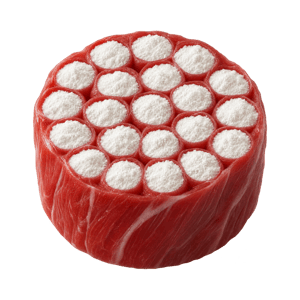
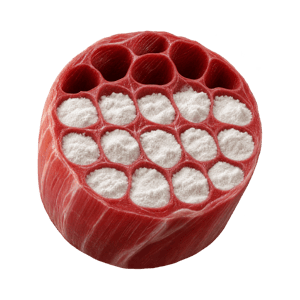
Think of two phones on the same charger, one at 60% and one at 80%. Both end at 100%, and the one that started lower took in a lot more charge on the way. Creatine works the same way, and the extra charge is what pays off in training.
Most improved: the trials
The clearest trial is from 2003. Burke’s team took 18 vegetarians and 24 meat eaters, aged 19 to 55, all recreational athletes with some lifting experience, and put them through the same 8-week lifting program. Half of each group took creatine and half took placebo, and the researchers took small muscle samples before and after. At the start, the vegetarians’ total muscle creatine was 117 against 130.
Vegetarians on creatineMeat eaters on creatine
- Phosphocreatine in the thigh muscle
- Total creatine in the thigh muscle
- Total work in 50 hard knee reps
Everyone on creatine gained more than everyone on placebo. But the vegetarians on creatine gained the most, with 2.4 kg of lean tissue against 1.9 kg for meat eaters on creatine and about 1 kg on placebo. The lower someone’s starting level, the bigger their gain. The 1992 study that started the creatine era saw the same thing, with the biggest rises, up to 50%, in the people who started lowest.
Other studies agree on the creatine levels. In one, five days at 0.4 g per kg raised thigh creatine 76% in vegetarians and 35% in meat eaters. A 2020 review of 9 studies found that vegetarians on creatine often ended up with more muscle creatine than meat eaters on creatine.
The limits are real, though. Most of these studies were small, and the 2020 review rated most of them at moderate to high risk of bias. Whether vegetarians also perform better than meat eaters on creatine was mixed. In one sprint cycling study, the meat eaters gained a little more peak power. The muscle gains in the Burke trial are the strongest evidence, and that’s one trial of 42 people.
The brain boost didn’t hold up
The other popular claim is that vegetarians get a bigger brain boost from creatine. Two early trials pointed that way. Then a 2023 trial of 123 people, about half of them vegetarian, found that “vegetarians did not benefit more from creatine than omnivores.” Vegetarians’ brain creatine seems to be about the same as meat eaters’, since the brain makes its own. Creatine for the brain has the whole story.
Is creatine vegan?
The creatine in tubs isn’t extracted from meat. A 2021 review describes how creatine monohydrate is made in Germany, by adding acetic acid to sodium sarcosinate, heating it, adding cyanamide and crystallizing the result. That gives 99.9% pure creatine monohydrate, and German-made creatine is what most research has used. The powder has no animal ingredients.
Two things to check. Capsules and gummies can be made with gelatin, which comes from animals, so read the label or look for a vegan mark. And some creatine made by other methods has been found to carry impurities, like dicyandiamide and dihydrotriazine, so pick a product with a third-party testing mark. Which creatine to buy has the rest.
Essential for you, good for everyone
Your body can make creatine, so it isn’t an essential nutrient in the textbook sense, but that sets a low bar. If you eat no meat or fish, you’re running on what your body makes, your muscle stores sit lower, and a cheap daily scoop brings them up to where everyone else is, and then some. Some researchers have suggested about 3 g a day of creatine for everyone, especially with age (ISSN 2017). We’d put vegetarians and vegans at the front of that line.
The protocol
For vegetarians and vegans who train, or want to.
- Take 3 to 5 g of creatine monohydrate powder every day, with a meal. Rest days too. You’ll be full in about four weeks.
- Skip loading. You’d get there sooner, but you don’t need to, and loading puts the most water on the scale.
- Check the form. Plain powder is vegan. Check capsules and gummies for gelatin, and look for a third-party test mark.
- Lift two or three days a week. The trial gains came with training. Without it, creatine has little to work with.
- Cover your protein. protein.guide has protein for vegans, for vegetarians and which plant proteins go together.
- Test one lift or benchmark before you start and at week eight. Our prove it calculator tells you if the change is real.
7 sources
- Kreider RB and others, International Society of Sports Nutrition position stand: safety and efficacy of creatine supplementation in exercise, sport, and medicine, JISSN, 2017pmc.ncbi.nlm.nih.gov
- Burke DG and others, Effect of creatine and weight training on muscle creatine and performance in vegetarians, Medicine and Science in Sports and Exercise, 2003pubmed.ncbi.nlm.nih.gov
- Kaviani M, Shaw K and Chilibeck PD, Benefits of creatine supplementation for vegetarians compared to omnivorous athletes: a systematic review, IJERPH, 2020pmc.ncbi.nlm.nih.gov
- Blancquaert L and others, Changing to a vegetarian diet reduces the body creatine pool in omnivorous women, but appears not to affect carnitine and carnosine homeostasis: a randomised trial, British Journal of Nutrition, 2018pubmed.ncbi.nlm.nih.gov
- Antonio J and others, Common questions and misconceptions about creatine supplementation: what does the scientific evidence really show?, JISSN, 2021pmc.ncbi.nlm.nih.gov
- Sandkühler JF and others, The effects of creatine supplementation on cognitive performance: a randomised controlled study, BMC Medicine, 2023pmc.ncbi.nlm.nih.gov
- Harris RC, Söderlund K, Hultman E, Elevation of creatine in resting and exercised muscle of normal subjects by creatine supplementation, Clinical Science, 1992pubmed.ncbi.nlm.nih.gov