Do vegetarians get more from creatine?
On this page
For muscle, probably yes. Vegetarians and vegans start with less creatine in their muscles, so the same daily dose has more room to fill, and in the one trial that compared diets, vegetarians gained more. For the brain, a 123-person trial found vegetarians got no extra benefit.
Creatine comes from meat and fish, so it’s easy to assume vegetarians are missing out, or that it’s a meat eater’s supplement in the first place. Some vegans skip it because they think it’s made from animals. And a popular idea online says vegetarians get a bigger brain boost from it. The trials back the first idea and not the other two.
What we’d do
If you lift and don’t eat meat, creatine is one of the better fits around. Take 3 to 5 g a day like anyone else, with no loading needed. Take it for your muscles and count anything for your brain as a bonus.
Where your stores start
Your body gets creatine two ways. About half of what you use each day comes from food, mostly meat and fish (a pound of raw beef or salmon has about 1 to 2 g). Your liver and kidneys make the rest. Take meat out of your diet and you lose the food half.
The International Society of Sports Nutrition puts the usual muscle level at about 120 units (mmol per kg of dry muscle) on a mixed diet, out of a ceiling near 160. Vegetarians come in at about 90 to 110.
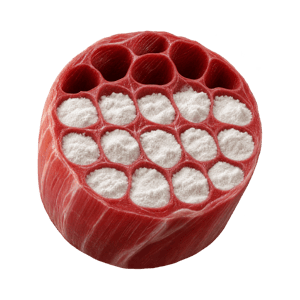
It’s like topping up a gas tank. A car that pulls in a third empty takes more fuel than one that’s nearly full, and both leave with a full tank.
The trial that compared them
In 2003 Darren Burke and colleagues put 18 vegetarians and 24 meat eaters, aged 19 to 55, through the same 8-week lifting program, with half of each group on creatine and half on placebo. At the start, the vegetarians’ muscle creatine was 117 against 130 for the meat eaters.
Everyone on creatine gained more than placebo. And the vegetarians on creatine gained more total creatine, more phosphocreatine, more lean tissue and more total work than the meat eaters on creatine. The lower someone’s starting level, the bigger their gain. An earlier 1992 study saw the same pattern, with the biggest rises, up to 50%, in people who started lowest.
It’s one trial with 42 people, so the size of the difference isn’t nailed down. The direction makes sense with everything else.
The brain idea didn’t hold up
The theory was that vegetarians, starting with less creatine, would see more of a brain boost. In 2023 Julia Sandkühler and colleagues tested it with 123 people, about half vegetarian and half meat eaters, giving them 5 g a day or placebo for six weeks each. They found evidence for a small benefit overall, and “vegetarians did not benefit more from creatine than omnivores.”
For vegans
Creatine monohydrate is made in a factory from two chemicals, sodium sarcosinate and cyanamide, with no meat involved. The powder itself is usually fine for vegans. Check capsules and gummies, which can use gelatin.
meals.guide has how vegetarians get enough protein at a meal, and the quiz gives you your verdict and your dates.
5 sources
- Kreider RB and others, International Society of Sports Nutrition position stand: safety and efficacy of creatine supplementation in exercise, sport, and medicine, JISSN, 2017pmc.ncbi.nlm.nih.gov
- Burke DG and others, Effect of creatine and weight training on muscle creatine and performance in vegetarians, Medicine and Science in Sports and Exercise, 2003pubmed.ncbi.nlm.nih.gov
- Harris RC, Soderlund K and Hultman E, Elevation of creatine in resting and exercised muscle of normal subjects by creatine supplementation, Clinical Science, 1992pubmed.ncbi.nlm.nih.gov
- Sandkuhler JF and others, The effects of creatine supplementation on cognitive performance: a randomised controlled study, BMC Medicine, 2023pmc.ncbi.nlm.nih.gov
- Antonio J and others, Common questions and misconceptions about creatine supplementation: what does the scientific evidence really show?, JISSN, 2021pmc.ncbi.nlm.nih.gov