Creatine damages your kidneys
Short answerNot the way you think
On this page
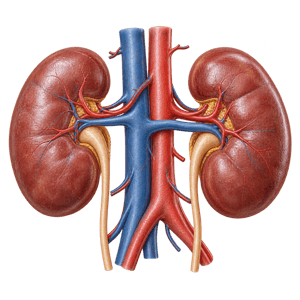
Not in healthy people. Creatine raises creatinine, the waste product a standard kidney test uses, by about 0.14 mg/dL on average. That makes the kidney score worked out from creatinine look lower. But across 26 trials, kidney filtering measured directly didn’t drop. If you already have kidney disease, ask your doctor before you take it.
What we’d do
If your kidneys are healthy, take 3 to 5 g a day without worrying about them. Before any blood test, tell whoever orders it that you take creatine and how much. If your creatinine comes back a little high, ask about a cystatin C test, which muscle and creatine barely move. If you have kidney disease, talk to your doctor first.
If you remember three things
- Creatine raises the number on the test. Creatinine went up about 0.14 mg/dL, and measured filtering didn’t change.
- Tell your doctor before a blood test. A few days off probably won’t clear the rise.
- Ask about cystatin C if creatinine is flagged. It barely depends on muscle.
Why people believe it
Because the number your doctor looks at goes up. Creatinine is the main kidney marker on a standard blood test, and creatine raises it. Anyone who sees “creatinine high” next to “takes creatine” can draw a straight line between them.
The fear also has a starting date. In 1998, doctors published a case about a young man who had had kidney disease for 8 years and had been on an immune-suppressing drug for 5. He started creatine, 15 g a day for a week and then 2 g a day, and his creatinine went up, so his doctors presumed his kidneys were getting worse. He stopped the creatine. A 2021 review notes that the case report ignored two things already known at the time, that creatine raises creatinine without harming the kidneys, and that his daily dose after the first week was about what a big steak carries. Two teams of creatine researchers wrote to the journal to say so, but the idea had already spread.
It’s like a line at a toll booth
Picture a toll booth that works at the same speed all day. Send more cars and the line gets longer, even though the booth is working just as fast. A creatinine test counts the line. Creatine sends more cars, because more stored creatine means more creatinine made each day. The booth, your kidneys, keeps working the same.
Why creatine raises creatinine
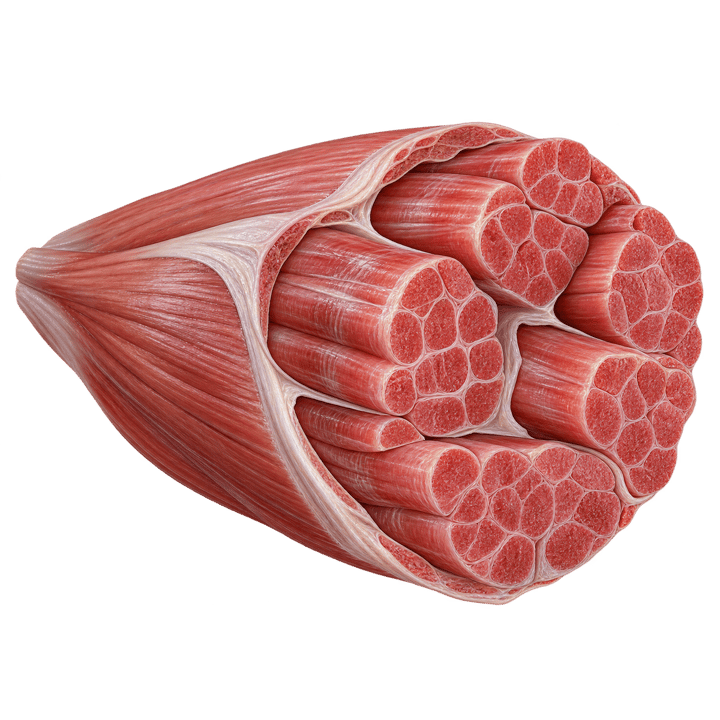
About 1 to 2% of the creatine in your muscles breaks down every day into creatinine, which your kidneys clear into urine. Fill your muscles with more creatine and you make more creatinine, so there’s a little more in your blood at any moment.
Your kidney score, the eGFR, is usually worked out from creatinine, your age and your sex, and it assumes an average amount of muscle making an average amount of creatinine. Give it a higher creatinine and it prints a lower score. It has no way to know the extra came from a scoop. People with a lot of muscle run into the same problem without any supplements.
What the trials found
The big picture
26 trials, 1,036 people. Review, 2026
Creatinine rose 0.14 mg/dL. The kidney score worked out from creatinine fell about 11 mL/min. Kidney filtering measured directly, with a tracer, didn’t fall. Urea and protein in the urine didn’t change.
The trials varied a lot in how much creatinine rose.
A second review
20 trials. Journal of Renal Nutrition, 2026
Creatinine rose 0.13 mg/dL. No difference in urea or in eGFR.
The authors want trials longer than a year.
The better test
18 healthy men, 3 months. University of São Paulo, 2008
On about 10 g of creatine a day with training, cystatin C, a kidney marker that muscle barely moves, didn’t rise. It fell in both groups.
A small trial, in young men.
Women after menopause
7 trials, 608 women. Review, 2026
Kidney measures were unchanged on creatine, in trials lasting up to two years.
Kidney safety wasn’t the main question.
The three numbers from the big review show the whole story in one look.
What about cystatin C?
Cystatin C is a small protein your body makes at a steady rate, cleared by the kidneys like creatinine but without the link to muscle. In a 2008 study of 170 healthy adults, creatinine tracked lean mass and cystatin C didn’t. The National Kidney Foundation says a cystatin C test can help when creatinine may mislead, including in people with a lot of muscle, though it may not be accurate with an untreated thyroid problem or on steroids. The creatinine check shows how your result compares with the rise creatine usually causes.
The best case for worry
There are a few case reports of kidney trouble in people taking creatine. In 2025, doctors described a 17-year-old who developed kidney injury after a six-day high-dose loading regimen, with both creatinine and cystatin C rising. A single case can’t show that creatine caused it. But it’s a fair reason why teenagers shouldn’t take creatine, especially in big loading doses, and why we don’t give a dose under 18.
For people who already have kidney disease, the trials are fewer. The International Society of Sports Nutrition notes that some experts suggest they check with their doctor first, out of caution, and we agree. Creatine changes one of the numbers their doctor uses to track their kidneys.
How long has this been tested?
Long enough to be reassuring. Creatine became a popular supplement in the early 1990s, and more than 1,000 studies have followed. Studies of patients have used up to 30 g a day for as long as five years. A 2021 review points out that if creatine harmed healthy kidneys, nearly 30 years of wide use would have turned up a rise in kidney damage among young, fit people, and it hasn’t.
9 sources
- de Souza Almeida A and others, Impact of creatine supplementation on kidney health: a systematic review and meta-analysis, International Urology and Nephrology, 2026pubmed.ncbi.nlm.nih.gov
- Tsiaras A and others, The effect of creatine supplementation on kidney function: a systematic review and meta-analysis of randomized controlled trials, Journal of Renal Nutrition, 2026pubmed.ncbi.nlm.nih.gov
- Antonio J and others, Common questions and misconceptions about creatine supplementation: what does the scientific evidence really show?, JISSN, 2021pmc.ncbi.nlm.nih.gov
- Gualano B and others, Effects of creatine supplementation on renal function: a randomized, double-blind, placebo-controlled clinical trial, Eur J Appl Physiol, 2008pubmed.ncbi.nlm.nih.gov
- Baxmann AC and others, Influence of muscle mass and physical activity on serum and urinary creatinine and serum cystatin C, Clin J Am Soc Nephrol, 2008pmc.ncbi.nlm.nih.gov
- National Kidney Foundation, Cystatin C, last updated July 26, 2023kidney.org
- Kreider RB and others, International Society of Sports Nutrition position stand: safety and efficacy of creatine supplementation in exercise, sport, and medicine, JISSN, 2017pmc.ncbi.nlm.nih.gov
- Naddafha S, Antonio J, Kreider RB, Stout JR, Creatine monohydrate for lean mass, strength, and bone density in postmenopausal women: a systematic review and meta-analysis, JISSN, 2026doi.org
- Filler G and others, Acute kidney injury with cast nephropathy following creatine loading in a 17-year-old, Pediatric Nephrology, 2025pubmed.ncbi.nlm.nih.gov