Is creatine bad for your kidneys?
On this page
Not in healthy people. Creatine raises creatinine, the number most kidney tests use, by about 0.14 mg/dL, so the kidney score worked out from it comes out lower. When researchers measured kidney filtering directly, it didn’t drop. If you already have kidney disease, ask your doctor before you take it.
This fear has a real starting point. People take creatine, get a routine blood test, and the report flags their creatinine as high and their kidney score (eGFR) as low. That looks exactly like the early sign of kidney trouble, and the doctor may not know about the tub at home.
What we’d do
Take 3 to 5 g a day and tell whoever orders your blood work that you take creatine. If your creatinine comes back high, ask about a cystatin C test, which muscle and creatine barely move. With kidney disease, ask your doctor before you start.
Why the number moves
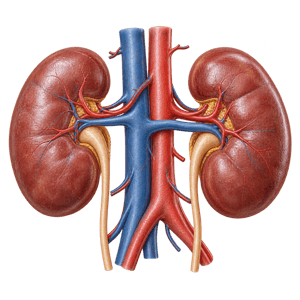
Creatinine is what creatine turns into when it breaks down. About 1 to 2% of the creatine in your muscles becomes creatinine every day, and your kidneys clear it. A standard kidney test measures how much creatinine is in your blood and works backward to how fast your kidneys must be filtering, assuming you make it at a normal rate.
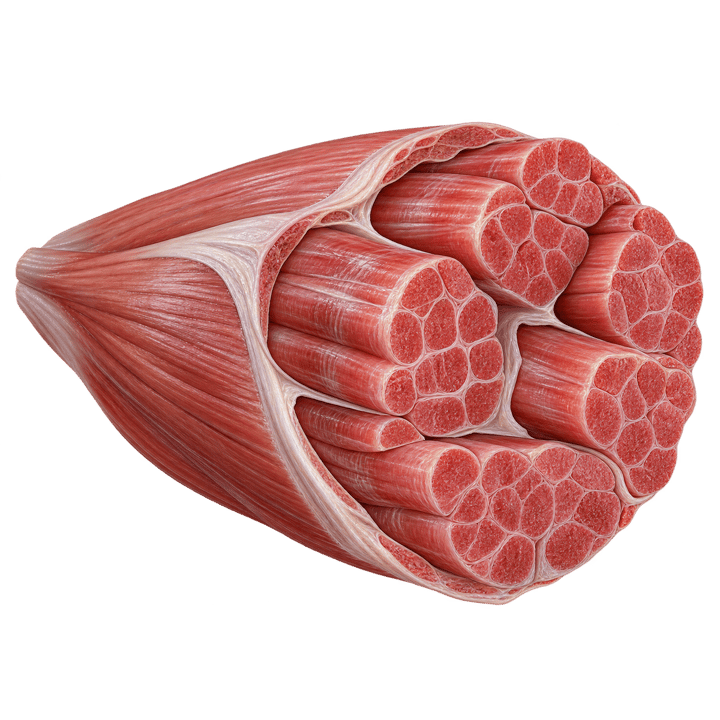
Creatine breaks that assumption. Fuller muscles make more creatinine, so there’s more in your blood even if your kidneys are working exactly as before.
It’s like judging how fast a sink drains by how full it is. Turn the tap up a little and the sink sits fuller, so it looks like it’s draining slower, while the drain is the same as ever.
What the trials found
In 2026 Artur de Souza Almeida and colleagues pooled 26 randomized trials with 1,036 people. They looked at creatinine, the kidney score worked out from it, and filtering measured directly.
| Measure | Change on creatine |
|---|---|
| Creatinine in the blood | Up 0.14 mg/dL (range 0.05 to 0.22), about 12 µmol/L |
| Kidney score worked out from creatinine | Down about 11 mL/min |
| Kidney filtering measured directly, with a tracer | No fall (plus 5.9 mL/min, within noise) |
They also found no change in urea or in protein in the urine, and concluded that the shift most likely reflects a change in how creatinine is made and handled rather than kidney injury. A second 2026 review of 20 trials, in the National Kidney Foundation’s nutrition journal, found the same creatinine rise, 0.13 mg/dL, and no difference in urea or eGFR.
The test that sidesteps creatinine is cystatin C. In a 2008 study of 170 healthy adults, creatinine went up with lean mass and cystatin C didn’t. Active people had higher creatinine (1.04 against 0.95 mg/dL) and the same cystatin C. In a 2008 trial, 18 healthy young men took about 10 g of creatine a day for three months, and their cystatin C fell slightly, the same as the placebo group’s. The National Kidney Foundation lists people with lots of muscle as one of the cases where cystatin C may be more accurate. It can be off in people with an untreated thyroid problem or on steroids.
Who should be careful
People with kidney disease are the clear exception. The International Society of Sports Nutrition says they should check with their doctor first, as a precaution. In 2025, doctors reported a 17-year-old who developed acute kidney injury after a 6-day high-dose loading plan. One case can’t show what caused it, but it’s one reason we give no dose under 18 and don’t push loading.
The creatinine check compares your result with what creatine usually adds. It never works out a kidney score and it isn’t a diagnosis.
Where the expert groups stand
- International Society of Sports Nutrition, 2017. No compelling evidence that creatine harms kidney function in healthy people or patient groups. People with kidney disease are advised to check with their doctor first.
- Two 2026 reviews of the trials, 26 and 20 trials. Creatinine rises 0.13 to 0.14 mg/dL, with no drop in filtering measured directly and no change in urea.
- National Kidney Foundation, updated 2023. Cystatin C may be more accurate than creatinine for people who have lots of muscle.
Checked against these sources on November 14, 2026.
7 sources
- de Souza Almeida A and others, Impact of creatine supplementation on kidney health: a systematic review and meta-analysis, International Urology and Nephrology, 2026pubmed.ncbi.nlm.nih.gov
- Tsiaras A and others, The effect of creatine supplementation on kidney function: a systematic review and meta-analysis of randomized controlled trials, Journal of Renal Nutrition, 2026pubmed.ncbi.nlm.nih.gov
- Gualano B and others, Effects of creatine supplementation on renal function: a randomized, double-blind, placebo-controlled clinical trial, European Journal of Applied Physiology, 2008pubmed.ncbi.nlm.nih.gov
- Baxmann AC and others, Influence of muscle mass and physical activity on serum and urinary creatinine and serum cystatin C, Clinical Journal of the American Society of Nephrology, 2008pmc.ncbi.nlm.nih.gov
- National Kidney Foundation, Cystatin C, updated 2023kidney.org
- Kreider RB and others, International Society of Sports Nutrition position stand: safety and efficacy of creatine supplementation in exercise, sport, and medicine, JISSN, 2017pmc.ncbi.nlm.nih.gov
- Filler G and others, Acute kidney injury with cast nephropathy following creatine loading in a 17-year-old, Pediatric Nephrology, 2025pubmed.ncbi.nlm.nih.gov