Creatine is just water weight
Short answerNot the way you think
On this page
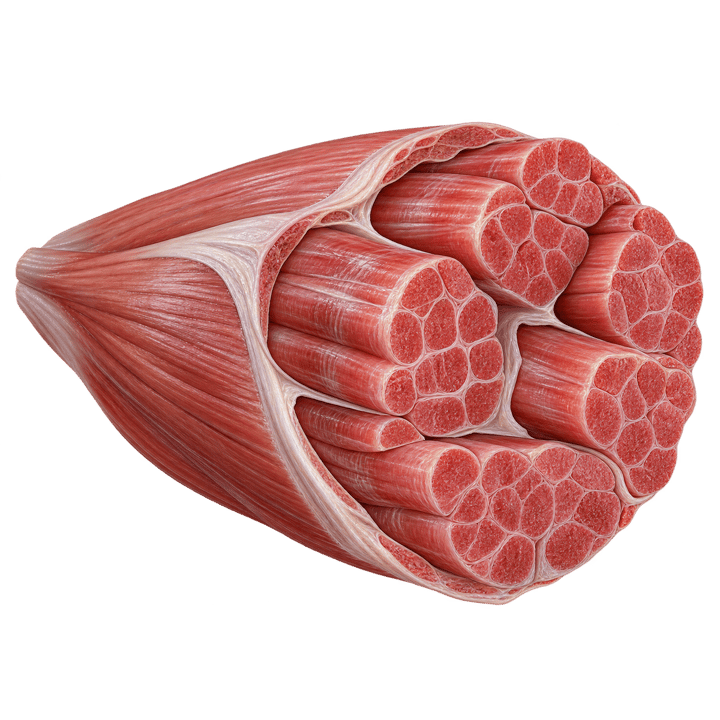
Not the way you think. The first week is mostly water. In one trial, body water rose 1.37 L in the loading week. But with lifting, creatine added 2.4 lb (1.1 kg) more lean mass than lifting alone across 35 trials, strength rose more, and in muscle samples the fast-twitch fibers grew more. The water comes first, and the muscle comes later, if you train.
What we’d do
Expect the water and ignore it. Judge creatine by a lift or a benchmark at week eight, and keep training at least twice a week, since without training the water is all you’ll get.
If you remember three things
- The early jump on the scale is water. It stops once your muscles are full.
- The later gain with lifting includes real muscle. Fibers grew more in muscle samples, and strength rose more.
- Without training, it’s mostly water. Lean mass didn’t move without exercise across 35 trials.
Why people believe it
Because the first thing creatine does is put water on the scale, fast. A loading week of about 20 g a day typically adds 1 to 3 kg (2 to 7 lb), mostly water. People see three pounds in a week, know that nobody builds three pounds of muscle in a week, and decide the whole thing is water.
They’re right about week one. The muscle, if it comes, comes over the following months of training.
It’s like a savings account with a sign-up bonus
Some savings accounts pay a bonus the day you open them. The bonus lands right away and never grows. The interest builds slowly, and only while you keep making deposits. Creatine’s water is the bonus. The muscle is the interest, and the deposits are your hard training sessions.
What the studies found
How much water
32 young adults who lifted, 2003. University of Virginia
On 25 g a day for a week, then 5 g, body water rose 1.37 L in the first week and was 2.04 L above the start by day 28. The share of water inside and outside the cells stayed the same.
The scale only showed 0.75 kg at day 7, less than the water, and the researchers couldn’t fully explain it.
How much lean mass
35 trials, 1,192 people. Review, 2022
With lifting, creatine added 1.10 kg (2.4 lb) of lean mass over lifting alone. Without exercise, 0.03 kg, which is nothing.
Lean mass on a scan includes water, so some of this is water too.
The muscle itself
42 adults, 8 weeks of lifting, 2003
Muscle samples showed the fast-twitch fibers grew more on creatine than on placebo, along with more strength and more work done.
A small trial, and cell water can swell fibers a little too.
Bigger arms and thighs
40 young adults, 8 weeks of lifting, 2024
All three creatine groups grew more arm and thigh muscle and gained more strength than the placebo group.
Ten people per group.
Why the water doesn’t explain the strength
Water doesn’t lift weights. Across 22 studies of creatine with weight training, strength rose 20% on creatine against 12% on placebo, and reps at the same weight rose 26% against 12%. Strength is measured by what you can lift, and extra water in a muscle doesn’t add that on its own.
The water also doesn’t keep coming. It travels into muscle with the creatine and stops once your muscles are full, around day 7 if you load and day 28 if you don’t. Several training studies of 5 to 10 weeks found no lasting rise in total body water at all. The lifting trials ran for weeks to months, well past the point where the water stops arriving.
And you can get the benefit with no water at all. In a 2011 trial, 20 young adults took about 2.3 g a day for 6 weeks. Their weight and body water didn’t change, and they still held up 7 to 11% better in the later sets of a hard leg test.
The best case for “it’s mostly water”
A 2025 trial makes it well. Researchers gave 63 adults 5 g a day or nothing. After one week, before any training, the creatine group had 0.51 kg (1.1 lb) more lean mass on a scan. Then both groups lifted for 12 weeks and both gained about 2 kg, with no extra gain on creatine. The researchers think the scan counted creatine’s water as lean mass, and that 5 g a day might not be enough to add muscle on top of training.
That’s a fair point about scans and about the first week. It’s one trial of 63 people, set against dozens that found more lean mass and more strength with lifting, and against muscle samples that showed bigger fibers. The fair answer is that early lean mass gains are partly water, and the long-run gains with lifting include real muscle.
Is the water a bad thing?
Not for most people. The water sits mostly in muscle, and it may even help, since water inside a muscle cell is one of the signals that tells it to build protein. The main downside is on the scale. If you’re dieting, it can hide a couple of weeks of fat loss, so watch your waist for the first month. What the scale will do has the numbers by weight.
8 sources
- Powers ME and others, Creatine supplementation increases total body water without altering fluid distribution, Journal of Athletic Training, 2003pmc.ncbi.nlm.nih.gov
- Antonio J and others, Common questions and misconceptions about creatine supplementation: what does the scientific evidence really show?, JISSN, 2021pmc.ncbi.nlm.nih.gov
- Delpino FM and others, Influence of age, sex, and type of exercise on the efficacy of creatine supplementation on lean body mass, Nutrition, 2022pubmed.ncbi.nlm.nih.gov
- Burke DG and others, Effect of creatine and weight training on muscle creatine and performance in vegetarians, Med Sci Sports Exerc, 2003pubmed.ncbi.nlm.nih.gov
- Eghbali E, Arazi H, Suzuki K, Supplementing with which form of creatine (hydrochloride or monohydrate) alongside resistance training can have more impacts on anabolic/catabolic hormones, strength and body composition?, Physiological Research, 2024pmc.ncbi.nlm.nih.gov
- Desai I and others, The effect of creatine supplementation on lean body mass with and without resistance training, Nutrients, 2025pmc.ncbi.nlm.nih.gov
- Rawson ES, Volek JS, Effects of creatine supplementation and resistance training on muscle strength and weightlifting performance, J Strength Cond Res, 2003pubmed.ncbi.nlm.nih.gov
- Rawson ES and others, Low-dose creatine supplementation enhances fatigue resistance in the absence of weight gain, Nutrition, 2011pubmed.ncbi.nlm.nih.gov