You need to cycle off creatine
Short answerNo
On this page
No. When you stop taking creatine, your muscle stores drift back to where they started over about a month, and they don’t drop below that. Your body keeps making its own creatine the whole time. A break only empties what you filled, and then you have to fill it again.
What we’d do
Take 3 to 5 g every day, with no planned breaks. If you want to stop, stop. Nothing bad happens, you’ll just lose the top-up over about a month and the water that came with it. Taking a break to reset something gains you nothing, because nothing needs resetting.
If you remember three things
- Stopping is safe. Stores fall back to where they started, never below.
- Your body doesn’t stop making its own. No study has found long-term suppression.
- A break just costs you weeks. About a month to drain, then weeks to fill again.
Why people believe it
Cycling comes from the world of drugs and hormones. Anabolic steroids can suppress the body’s own testosterone, so the idea of coming off to let the body recover makes sense there. It seems natural to assume creatine works the same way, and that your body will stop making its own creatine, or stop responding, if you never take a break.
The trials don’t back that up for creatine.
It’s like draining a full water tank
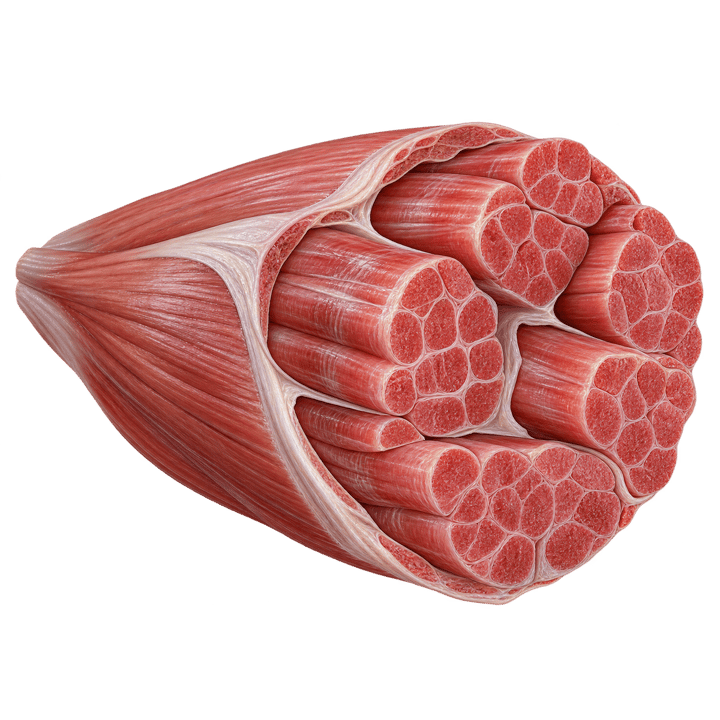
Picture a water tank that’s full and staying full. Draining it every few months so you can refill it doesn’t make the tank work better. It just means you spend weeks with less water in it. The tank was never the problem. Your muscles are the tank, and a creatine break is the drain.
What happens when you stop
In 1996, Hultman’s group followed men after a loading week. The men who kept taking 2 g a day stayed full. The ones who stopped drifted back down, and 30 days after their last dose their muscle creatine was no different from where it started. The International Society of Sports Nutrition puts the drop at 4 to 6 weeks, and says no evidence has shown muscle creatine falling below its starting level after people stop.
Here’s what that looks like for someone who starts on 3 to 5 g a day on Monday, November 16, and stops at week eight.
The curve between the measured days is drawn by us. The measured points are full at about day 28 on 3 to 5 g a day, and back to the start about 30 days after stopping.
Does your body stop making its own?
No evidence says it does over the long run. The International Society of Sports Nutrition says that because muscle creatine doesn’t fall below its starting level after people stop, long-term suppression of the body’s own creatine making doesn’t appear to happen. Your liver and kidneys keep making it, and you keep eating it in meat and fish.
That’s the key difference from steroids, which can shut down the body’s own hormone supply. Creatine tops up a store that your body fills by itself, and when you stop topping it up, the store settles back to its usual level.
Do you stop responding over time?
The long trials say no. In a two-year trial, 237 women around 59 took creatine every day while they lifted and walked. Two years in, they were walking faster than the placebo group and gaining a little more lean tissue among those who stuck with it. A 2026 review of seven trials in women after menopause, lasting up to two years, found strength and lean mass gains with no sign of harm.
Is long-term use safe?
As far as the studies go, yes. Creatine has been a popular supplement since the early 1990s, and more than 1,000 studies have followed. Patient studies have used up to 30 g a day for as long as five years. The International Society of Sports Nutrition found no compelling evidence that long-term creatine use harms healthy people.
When a break makes sense
There are a few practical reasons to stop. If you’re pregnant or breastfeeding, ask your doctor first. If you develop kidney disease, talk to your doctor. If you’re losing weight and want the scale to show only fat for a while, coming off for a month will remove the water. None of these is cycling. They’re reasons to stop, and you can start again whenever you like.
6 sources
- Hultman E and others, Muscle creatine loading in men, J Appl Physiol, 1996pubmed.ncbi.nlm.nih.gov
- Kreider RB and others, International Society of Sports Nutrition position stand: safety and efficacy of creatine supplementation in exercise, sport, and medicine, JISSN, 2017pmc.ncbi.nlm.nih.gov
- Antonio J and others, Common questions and misconceptions about creatine supplementation: what does the scientific evidence really show?, JISSN, 2021pmc.ncbi.nlm.nih.gov
- Chilibeck PD and others, A 2-yr randomized controlled trial on creatine supplementation during exercise for postmenopausal bone health, Med Sci Sports Exerc, 2023pmc.ncbi.nlm.nih.gov
- Hollis E and others, Persistent secondary hypogonadism following chronic opioid and anabolic steroid exposure: a case report, Cureus, 2026pmc.ncbi.nlm.nih.gov
- Naddafha S, Antonio J, Kreider RB, Stout JR, Creatine monohydrate for lean mass, strength, and bone density in postmenopausal women: a systematic review and meta-analysis, JISSN, 2026doi.org